A balance of science, creativity, and use of high quality ingredients is essential to succeed in the perfume industry. Aroma chemicals vs essential oils are both considered fragrance components to create unique fragrances; they differ significantly in composition, performance, cost, and application.
For those in the perfume industry, the decision to choose either aroma chemicals or essential oils varies according to their intended use, which affects consistency, cost performance and product quality. By understanding the strengths and weaknesses associated with aroma chemicals and essential oils, Fragrance manufacturers can create a fragrance that meets their consumer as well as their company objectives.
What Are Aroma Chemicals?
Aroma chemicals are fragrance compounds used to create specific scent profiles in perfumes and personal care products. Aroma chemicals may be derived from a natural source or created with the help of a chemical process.
Aroma chemicals enable perfumers to create or enhance natural scents while also, excitingly, developing entirely new olfactory experiences that may not exist in nature. Aroma chemicals are widely used, as they provide perfumers with a means of consistency across production batches, scalability, and durability.
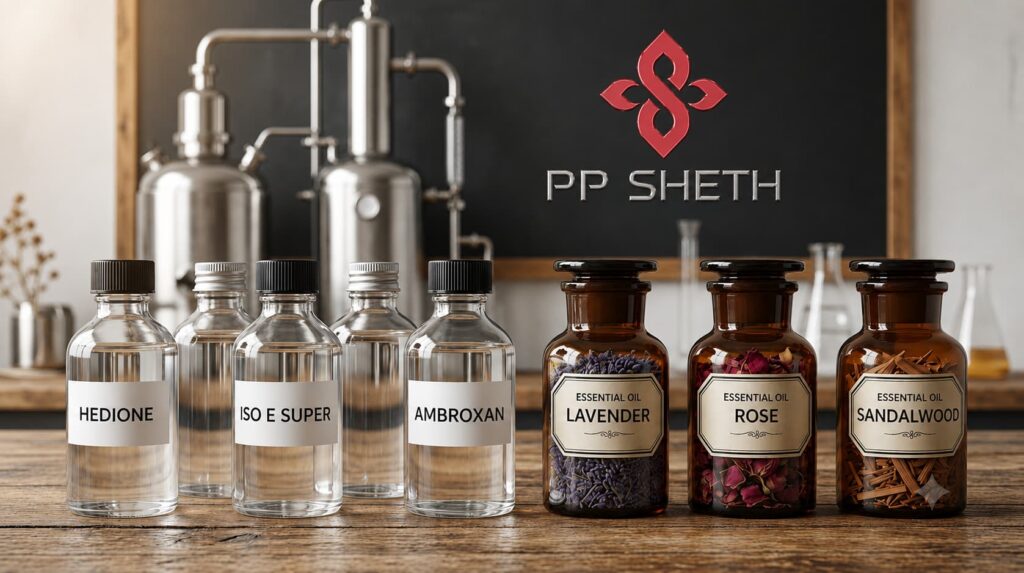
Some examples of aroma chemicals include:
- Hedione
- Iso E Super
- Ambroxan
- Galaxolide
- Linalool
Since the advent of modern perfuming, there has been a large dependency on aroma chemicals to achieve long lasting and varied fragrance compositions.
To learn more about how we source these ingredients, read our guide on choosing the right aroma chemicals manufacturers for high-quality fragrance
What Are Essential Oils?
Essential oils are highly concentrated plant based substances that can be extracted from the flowers, leaves, roots, fruit, barks, and seeds of the plant. They contain both the natural aroma and the various active ingredients of that plant; the extraction of the essential oil is done using steam distillation or cold pressing.
Popular essential oils used in perfumery include:
- Lavender
- Rose
- Sandalwood
- Bergamot
- Jasmine
Essential oils are generally preferred due to their natural origins and distinctive smells. Essential oils are commonly found in natural perfumes, aromatherapy products, skin care formulations, and wellness products.
Since essential oils are agricultural products, their composition may be quite different depending on the climate, harvest conditions, or method of extraction.
Aroma Chemicals vs Essential Oils: Key Differences
Both essential oils and aroma chemicals are natural based substances that will add scent or aroma to a product, but there are notable differences between the two.
Consistency: Aroma chemicals produce a consistent aroma between different batches. Essential oils vary batch to batch due to environmental influences.
Stability: Aroma chemicals typically provide a more stable product for use in finished goods than essential oils. Essential oils will typically become oxidised or degrade more quickly.
Cost: The majority of essential oil extraction requires many tens or even hundreds of kilos of raw plant materials, which makes their use prohibitively expensive. Aroma chemicals are usually much more price effective for the manufacture of finished goods in bulk.
Sustainability: Many botanicals that are used to produce essential oils are in danger of dwindling due to overharvesting. Aroma chemicals can alleviate the need for some endangered species of plants by providing alternatives and promoting sustainable practices.
Creativity: Aroma chemicals provide a perfumer the opportunity to create an entirely unique scent that would not otherwise be possible using only plant based oils.
Aroma chemicals can alleviate the need for some endangered species of plants by providing alternatives and promoting sustainable practices. To better understand how these synthetics evolved alongside nature, read our foundational guide on what are aroma chemicals with their history & uses.
Why Most Commercial Perfumes Use Aroma Chemicals
By utilising aroma chemicals, most modern perfumes and industrial fragrance oils achieve a higher level of stability and creative flexibility than is possible with natural ingredients alone. To see how these compounds form the backbone of commercial supply chains, read our breakdown of the essential perfume raw materials used by modern fragrance manufacturers.
Manufacturers prefer aroma chemicals because they:
Provide a consistent profile of fragrance.
- Improve fragrance longevity
- Support large-scale production
- Reduce formulation costs
- Meet regulatory requirements more easily
A number of popular classic fragrance ingredients, like marine scents, clean musks, and ambers, are only available through the use of aroma chemistry.
Without aroma chemicals, many modern day designer or luxury fragrances would not exist in their current format.
Can Essential Oils Replace Aroma Chemicals?
In most cases, essential oils cannot completely replace aroma chemicals for the production of commercial grade perfumes.
Even though essential oils provide natural variety and authenticity to a fragrance, they also have certain limitations related to price, stability, and ease of use. In addition, there are some scent profiles that simply can’t be achieved using natural ingredients alone.
However, essential oils remain valuable for:
- Organic personal care products
- Natural perfume formulations
- Aromatherapy applications
- Premium niche fragrances
Several different types of scents can be achieved with essential oils and aroma chemicals working together to create a balance of natural and efficient performance.
Which Aroma Chemicals Are Used in Luxury Perfumes?
Luxury fragrances often incorporate advanced aroma chemicals to develop brands’ signature fragrance compositions.
Some commonly used ingredients include:
- Ambroxan: Warm Amber/Wood, Long Lasting
- Iso E Super: Smooth Woods, Enhances Diffusion.
- Hedione: Bright Jasmine Type Fresco, Enhances Overall Radiance
- Cashmeran: Warm/Musky/Wood
- Galaxolide: A popular musk ingredient that adds softness and depth
The combination of these chemicals results in complex, long lasting signature fragrances for premium fragrance houses. Therefore, they are a large part of how these premium fragrance houses stand out from their competition.
How Fragrance Manufacturers Choose Between Aroma Chemicals and Essential Oils
There are several factors that fragrance manufacturers consider when choosing an ingredient for their fragrances.
Product Positioning: Luxury natural brands would usually focus on sourcing pure plant extracts from reliable Essential Oil Manufacturers in India, while mass-market brands will typically focus more on using aroma chemicals.
Budget Requirements: The cost of an ingredient is a key factor when choosing an ingredient, particularly for a large fragrance manufacturer.
Performance Expectations: A fragrance that lasts will typically require aroma chemicals to be at the same performance level as a fragrance that does not last as long.
Regulatory Compliance:Regulations and safety standards must be adhered to by fragrance manufacturers to safeguard against liability. If you are using global portfolios like BASF, check out our walkthrough on how to identify the right BASF aroma ingredient for your compliance requirements.
Sustainability Goals: The majority of brands use a combination of both natural and sustainable aroma ingredients to limit their impact on the environment. As a result of these factors, many successful fragrances use both methods to result in the best possible fragrance.
Conclusion
The Aroma Chemicals vs. Essential Oils debate isn’t just about selecting the preferred type but rather about how each works together in creating a fragrance.
Through the use of aroma chemicals, consistency, performance, innovation, and cost efficiency become paramount aspects of the current day perfumery industry. Essential oils provide consumers with the natural richness and versatile applicability they seek from plant based ingredients.
When utilising aroma chemicals and essential oils collectively, brands produce high quality fragrances that not only create amazing smelling products but also help them with viability and sustainable practices.
FAQs
Are aroma chemicals safe for perfumes?
Yes, aroma chemicals used in perfume are extensively studied, tested, and regulated by the industry to ensure they are safe for use when used correctly.
Why do perfumes use synthetic ingredients?
Synthetic materials allow perfumers to achieve a consistent fragrance profile, improve longevity, reduce costs, and enable scent profiles that cannot be obtained from natural materials alone.
Do luxury brands use aroma chemicals?
Yes, luxury brands use a combination of both aroma chemicals and naturally derived materials to achieve complexity, performance, and uniqueness.
Are aroma chemicals stronger than essential oils?
Some aroma chemicals offer more stable, stronger projection, and longevity compared to many of the equivalent essential oils; however, their performance vary based on the specific ingredient.
Which option is more cost-effective for manufacturers?
Aroma chemicals are less expensive than most essential oils, as they provide a consistent level of quality, scalable production, and lower sourcing costs compared to many essential oils.
Most Recent Posts