
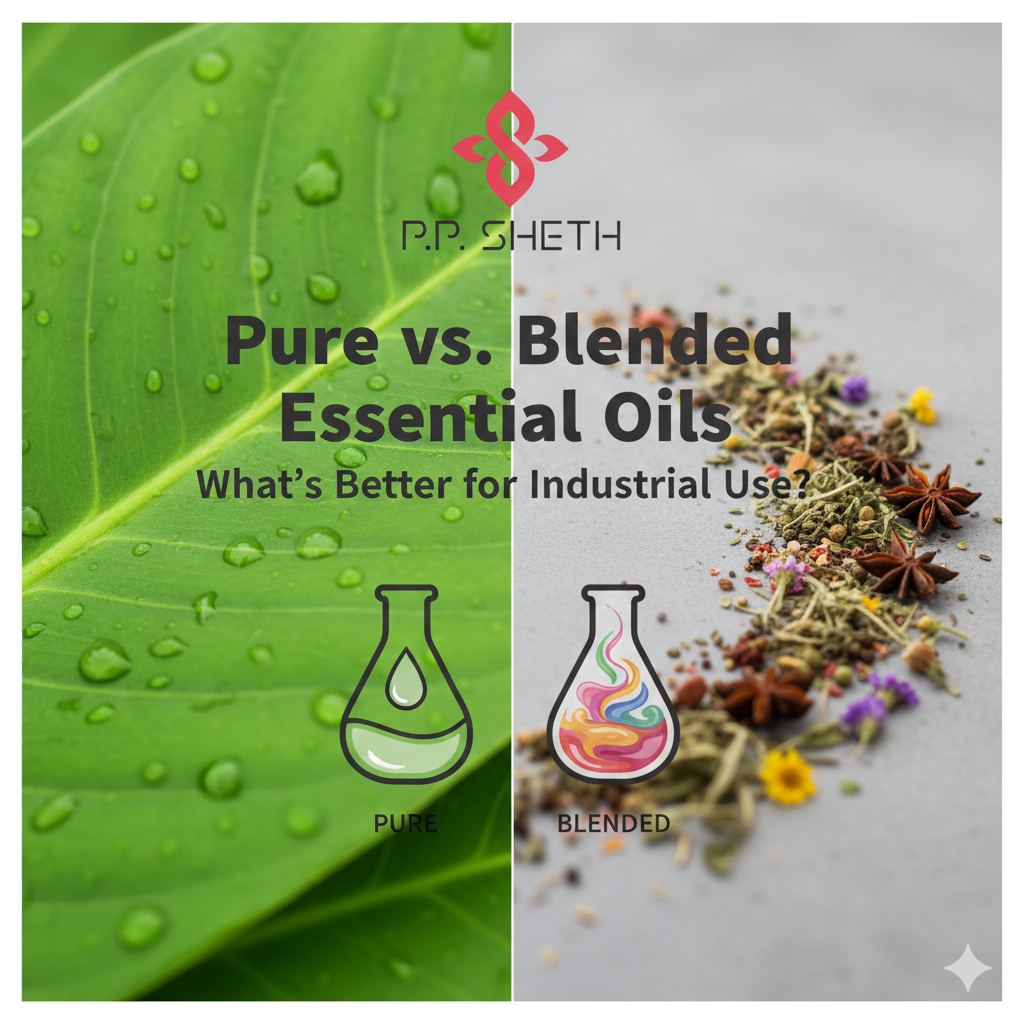
Essential oils have secured a place in our lives and in multiple industries: cosmetics, personal care, wellness, home fragrance, aromatherapy, FMCG, and even household cleaning formulations. As the demand for essential oils increases, so too does the responsibility of cataloguing and performing ingredient suppliers to deliver oils of a consistent quality, budget-friendly, reasonable production yield, and respectable brand value.
As brands consider the options for experimentation, industrial brand buyers are typically influenced by reliable natural essential oil supplier India and the vast network of essential oil manufacturers in India, which often supply pure and blended essential oils and natural fragrance oils in bulk.
But the real question is: Should industrial brands be using pure essential oils or blended essential oils, or a combination of each?
Today, we’ll paint a landscape of strengths and weaknesses for each category to help the decision maker choose one category over the other for their specific product category and production needs of scale.
Understanding Pure Essential Oils
What Is Pure Essential Oil?
Pure essential oils are distilled extracts of a plant, taken directly from the flower, leaf, root, peel, or resin using methods of extraction such as steam distillation, cold pressing, and CO₂ extraction, with the essential characteristic being that pure essential oils are not diluted, and they do not have synthetic compounds or additives.
Because they contain all the aromatic and therapeutic components of the plant, pure natural essential oils are often considered the pinnacle of luxury in beauty and wellness products.
Pure Essential Oils Advantages for Industries
Pure essential oils bring added value to premium segments of manufacturing, including:
- Stronger, richer aroma: Suitable for mass-market perfumes, aromatherapy blends, and skincare for those who are selling superior market products.
- Higher price point: family, company, and product brands can justify a premium price point for products using pure oils.
- Therapeutic value: industries such as spas, wellness and Ayurveda require natural purity.
- Authenticity: adding differentiation in very synthetic fragrances in markets.
Pure Essential Oil Limitations for Industries
Although pure oils offer some prestige, they also come with disadvantages:
- High Cost: mass product manufacturing can be expensive on a larger scale.
- Inconsistent Aroma: every growing season natural crops may vary, affecting scent consistency.
- Less scaling: this always depends on harvest cycles and climate.
- Inadequate for standard formulas: brands need identical aroma batches often prefer blends.
Understanding Blended Essential Oils
What are blended essential oils?
Blended essential oils are products developed through the combination of various essential oils, or a combination of essential oils and aromatic materials, to provide greater consistency of fragrance, stability, or cost-effectiveness.
For this, a number of the best essential oil brands and companies that develop fragrances for industry use blended oils in their production to meet their production budgets and to achieve a consistent scent profile.
Industrial Advantages of Blended Essential Oils
From an industrial viewpoint, blended oils offer price advantages to manufacturers of essential oils, and typically the advantages for a large vendor are in the following areas:
- Economically advantageous: You can significantly decrease the raw material cost while not losing the complexity of scent.
- Consistency: Every batch produced will smell the same. This is key for cosmetics and fast-moving consumer goods.
- Customisation: Brands can request a custom signature smell as a blend such that it’s associated with their identity.
- Stability: A blended essential oil reduces the variance associated with naturally sourced oils.
- Supply chain scalability: Blended essential oils are easier to generate in large batches consistently.
Disadvantages of Blended Oils
Even though blended oils can help to overcome some of the challenges faced in making things reliably, they do have some disadvantages:
- Not always viewed as a 100% natural essential oil.
- Reduced therapeutic effect depending on the blend.
- You still need to use a supplier you trust to avoid adulteration or synthetic fillers.
Pure vs Blended Essential Oils: Deep Comparison for Industrial Buyers
| Factor | Pure Oils | Blended Oils |
| Cost | High | More affordable |
| Aroma Consistency | Moderate | High |
| Industrial Suitability | Premium markets | Mass-market products |
| Flexibility | Limited | Highly customizable |
| Shelf Stability | Moderate | Higher |
| Supply Volume | Lower availability | Easily scalable |
Which Option Is Better for Your Industry?
Cosmetic & Skincare Manufacturers
- Pure oils: best for serums, anti-ageing products, massage oils, and high-end skincare.
- Blended oils: generally preferred for lotions, creams, body washes, and mass-market beauty products.
Perfume & Fragrance Brands
Perfumers usually take a hybrid route:
- Pure essential oils provide authenticity and complexity.
- Blended oils offer stable/repeatable signature notes essential for branding.
Homecare & Cleaning Product Manufacturers
Blended oils are usually the better option:
- Cost-effective
- Lasting fragrance
- Stable aroma when mixed with strong surfactants
Wellness, Spa & Ayurveda Companies
This space prioritises purity and natural therapeutic properties. A partnership with a natural essential oil supplier will provide you with exceptional pure oils for:
- Massage oils
- Diffuser blends
- Ayurvedic products
- Herbal balms
FMCG Companies
FMCG products require:
- Strong aroma
- Lower cost
- Scalable availability
For this reason, blended essential oils are the greater practical aspects for soaps, deodorants, shampoos and cleaning products.
Explore More: Top 10 Essential Oil Manufacturers in India
Significance of Selecting Appropriate Essential Oils Manufacturers in India
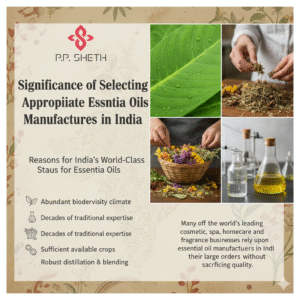
Reasons for India’s World-Class Status for Essential Oils
India has built a strong reputation globally due to:
- Abundant biodiversity and exemplary climate for growth
- Decades of traditional expertise in extraction
- Sufficient available crops to fulfil bulk orders
- Robust distillation and blending capabilities
Many of the world’s leading cosmetic, spa, homecare and fragrance businesses rely upon essential oil manufacturers in India to fill their large orders without sacrificing quality.
What Industrial Buyers Should Look for in a Supplier
- Certifications: ISO, GMP, HACCP, Organic
- COA and GC/MS on a batch-wise basis
- Ability to produce strong bulk orders
- Transparency around the source location
- Ability to supply pure and blended essential oils
- Competitive pricing and support with exporting
Why Sourcing From a Reputable Natural Essential Oil Supplier India Matters
Choosing a reputable natural essential oils manufacturer provides:
- Assurance of purity and quality
- Consistency of aroma profile
- Bulk orders delivered on time
- Less risk of chemical adulteration
- Better performance of end products
How to Evaluate the Best Essential Oil Brands for Industrial Use
Those in industry must consider:
- Raw material Sourcing (traceable from field to factory)
- Manufacturing capabilities (advanced distillation, CO₂ extraction)
- Formulation expertise (additive formulations, stability)
- Aromatic consistency across batches
- R&D collaboration through sampling
Cost Comparison: Pure vs Blended Oils for Industrial-Scale Production
- Pure oils can raise per-unit cost driven by excessive raw materials and extraction process complexity.
- Meanwhile, blended oils aid the lowering of total production costs, allowing large brands to achieve volume without downgrading the quality of fragrance.
Examples:
- Perfume brands often take multiple pure essential oils and blend them into a stable signature fragrance.
- Homecare brands often look to use blends to get refreshing, longer-lasting scents in their products.
- Personal care companies often create blends to help their budget allocation but still keep a product with an appealing aroma.
Sustainability Aspects
- Pure essential oils use more plant/vegetable matter, so more agriculture is required.
- These blended oils use fewer resources and promote sustainable practices.
- These oils are ethically sourced from essential oil manufacturers in India with respect to fair trade, environmentally responsible farming and low environmental impact.
Final Recommendation: What Should Industrialists Choose?
Here is a crystal-clear recommendation:
Select Pure Essential Oils If You Are Producing:
- High-end perfumes
- Premium skin-lotion products
- Wellness/spa/Ayurveda expertly crafted products
- Investment-grade aromatherapy blends
Select blended essential oils if you are Producing:
- Mass-market cosmetics
- Fast-Moving Consumer Goods (FMCG)
- Homecare and cleaning products
- Soaps, detergents, shampoos, and deodorants
Balanced Approach
Many industrial brands take one of those (or both) approaches. They will have their blended oils in their mass-market lines, but a pure essential oil in their flagship or premium line.
Ultimately the decision comes down to product positioning, budget, market demand, and sustainability.
Also Explore: aroma chemicals
Conclusion
Both pure and blended essential oils have unique benefits in industrial manufacturing. Pure oils can improve the quality of your premium product formulation, and blended oils can provide consistent quality, lower price per gallon costs, and larger production scale options.
Ultimately, the most important step is selecting the right partner.
Whether you partner with a reputable natural essential oil supplier in India or one of the leading essential oil manufacturers in India, they will help you evaluate options, create customised blends, conduct quality and purity assurance, and support supply logistics.
For businesses that are ready to scale and increase the overall natural fragrance and flavour experience, an expert supplier can also assess the benefits of bulk orders, custom research and development, and scaled branded fragrance solutions.