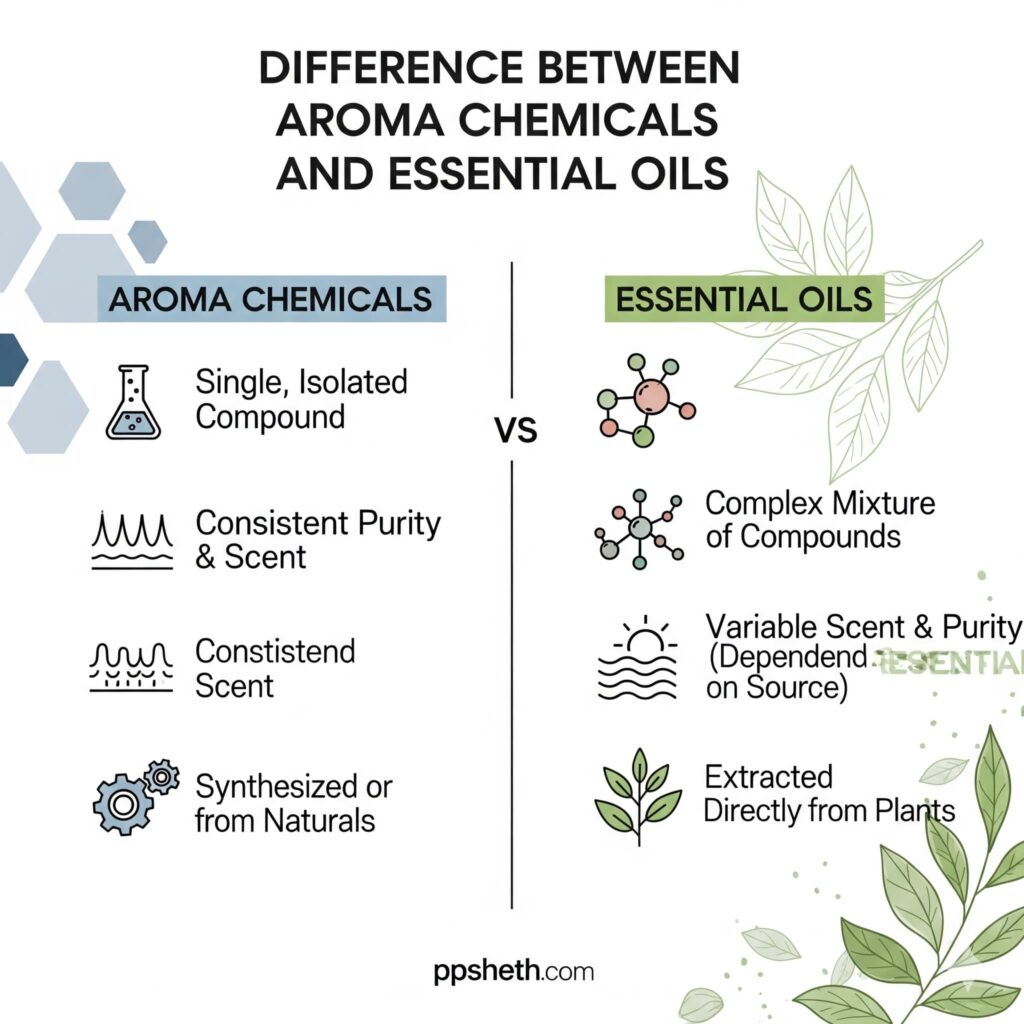
The development of modern perfumes involves combining the elements of nature with those of science. Essential oils provide authenticity and botanical richness to perfumes, while aroma chemicals offer precision and consistency, along with good performance. Both aroma chemicals and essential oils are the primary components of fragrances, personal care products, home fragrances, and health products.
It is essential that fragrance brands understand the differences between aroma chemicals and essential oils to ensure they make sound choices when developing their formulations; this will help them develop fragrance products that have the desired quality, stability, cost, and scale. Brands should also understand when to use which type of ingredient so that they can make commercially viable and beautiful products.
Understanding Essential Oils (The Natural Route)
Essential oils are made entirely from natural plant materials, including flowers, leaves, stems, bark, seeds, or roots. They are converted into essential oils using methods such as steam distillation and cold pressing to conserve their essential characteristics. The extracted essence contains the complete natural fragrance of the plant; therefore, the finished product is used in aromatherapy, natural perfumes, and clean-label products.
Essential oils have rich, multifaceted aromas that evoke familiarity to their users. For example, the lavender, peppermint, eucalyptus, and citrus oils provide a wide range of both sensory and therapeutic characteristics.
However, the quality of the essential oil can be influenced by weather/climatic conditions, growing conditions, and times of harvest; therefore, purity and sourcing are critical components of evaluating an acceptable supplier. Leading essential oil suppliers in India take into consideration how their essential oils were distilled or otherwise extracted, as well as whether they conform to multiple batch quality testing and evaluation.
Understanding Aroma Chemicals (The Synthetic Precision)
Aroma chemicals are synthetic or isolated from natural sources and comprise an individual fragrance molecule. Aroma chemicals provide precise control over scent, stability, and reproducible results in comparison to essential oils.
By utilising aroma chemical ingredients, perfumers are able to recreate specific notes like musk, amber, or marine accords that do not exist in nature or would be too expensive to extract from natural sources. Aroma chemicals also enhance the durability, projection, and overall performance of a fragrance.
Partnering with experienced aroma chemical manufacturers enables brands to achieve consistent quality, scalable production, and a cost-effective solution. Owing to their versatility, aroma chemicals are highly prized by perfumers for use in mass-produced products such as detergents, cosmetics, and mass-market perfumes.
Key Differences between aroma chemicals and essential oils
| Feature | Essential oils | Aroma Chemicals |
| Source | Plant-Based Extraction | Synthetic or isolated molecules |
| Scent Profile | Complex and natural | Precise and controlled |
| Consistency | May vary by harvest | Highly consistent |
| Cost | Often higher | More cost-effective |
| Longevity | Moderate | Long-lasting |
| Scalability | Limited by crops | Easily scalable |
Sourcing the Right Ingredients in India
Sourcing high-quality ingredients is of equal value as formulation within the fragrance industry; purchasing large volumes of product in bulk from suppliers who consistently provide products that meet purity standards, providing product delivery on time, and abiding by regulatory guidelines are critical aspects.
Fragrance companies frequently source large volumes of standardised raw materials at competitive prices using established aroma chemical wholesalers in India; additionally, developing relationships with the best essential oil brands in India provides businesses with access to unadulterated natural extracts.
When evaluating potential supplier relationships, consider:
- Consistency of product and performance testing
- Certifications for product safety and compliance
- Capacity for manufacturing the required quantity of raw materials
- Clarity surrounding the supplier’s procurement methods
- Reliability of both supplier logistics and supply chains.
A good working relationship with the supplier reduces risk and supports long-term company growth.
Conclusion
Aroma chemicals and essential oils have significant roles in the formulation of today’s fragrances. Essential oils help to provide a fragrance with richness and authenticity, while aroma chemicals offer precision, performance, and scalability.
A fragrance brand’s best strategy is NOT to CHOOSE between essential oils and aroma chemicals but to use both in an intelligent way by sourcing quality ingredients from trustworthy supply partners and maintaining a balanced formulation strategy throughout the process so that the final product is consistent, innovative, and marketable.
In this highly competitive industry, success is found by combining nature and technology together.
Most Recent Posts