
Introduction
Vanilla is one of the most familiar and widely used aroma profiles in fragrance and flavor development. It can add warmth, sweetness, creaminess, and comfort to a product. However, not every vanilla ingredient delivers the same result.
Formulators may choose between vanillin, ethyl vanillin, and natural vanilla depending on the desired aroma, product type, performance, sourcing requirements, and budget.
Vanillin provides the familiar core vanilla note. Ethyl vanillin offers a more intense vanilla character, while natural vanilla contains a wider range of aromatic compounds that create a more layered profile. These ingredients can sometimes be used together, but they are not identical or automatically interchangeable.
This guide explains the key differences and practical points to consider when selecting a vanilla ingredient for perfumes, cosmetics, food, and flavor applications.
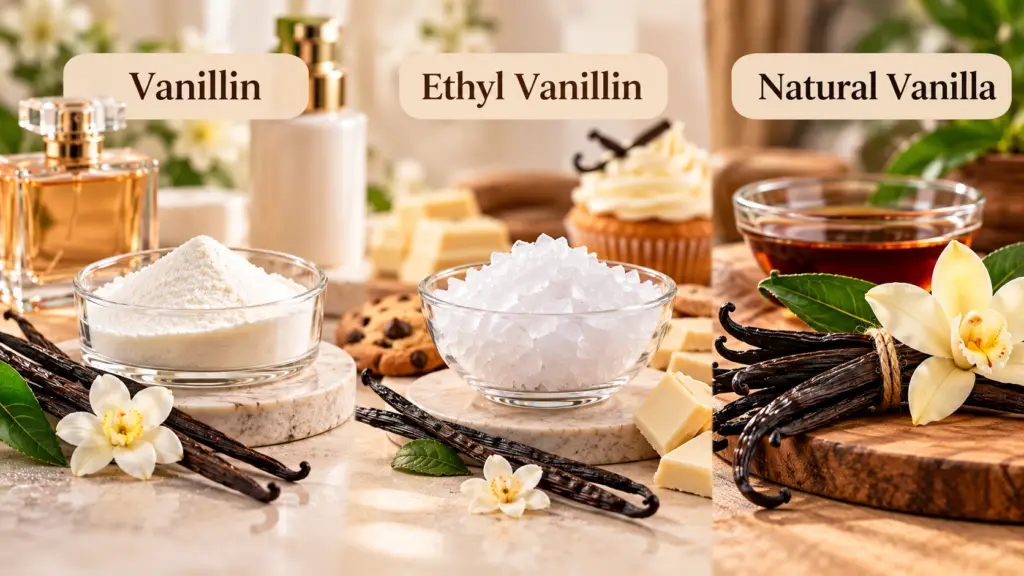
What Is Vanillin?
Vanillin is an aromatic compound known for its characteristic vanilla smell and taste. It is the main aroma compound associated with vanilla beans and is widely used in fragrance and flavor formulations.
Vanillin may be obtained from different sources, including synthetic production and certain natural-source processes. The source and manufacturing method matter when a product has specific sourcing or labeling requirements.
Aroma and Flavor Profile
Vanillin is commonly described as:
- Sweet and warm
- Creamy and smooth
- Softly woody
- Slightly powdery or balsamic
Its familiar profile makes it useful in formulations where the vanilla note should feel rounded rather than extremely strong.
Common Applications of Vanillin
Vanillin is used in a range of products, including:
- Fine fragrances and body sprays
- Perfumed creams and lotions
- Soaps and personal care products
- Bakery and confectionery flavors
- Dairy-style and dessert flavors
- Chocolate and beverage flavor systems
In perfumery, vanillin can support gourmand, amber, sweet, and warm fragrance directions. In food flavoring, it provides a recognizable vanilla character, although the final result depends on the full formulation and the product matrix.
What Is Ethyl Vanillin?
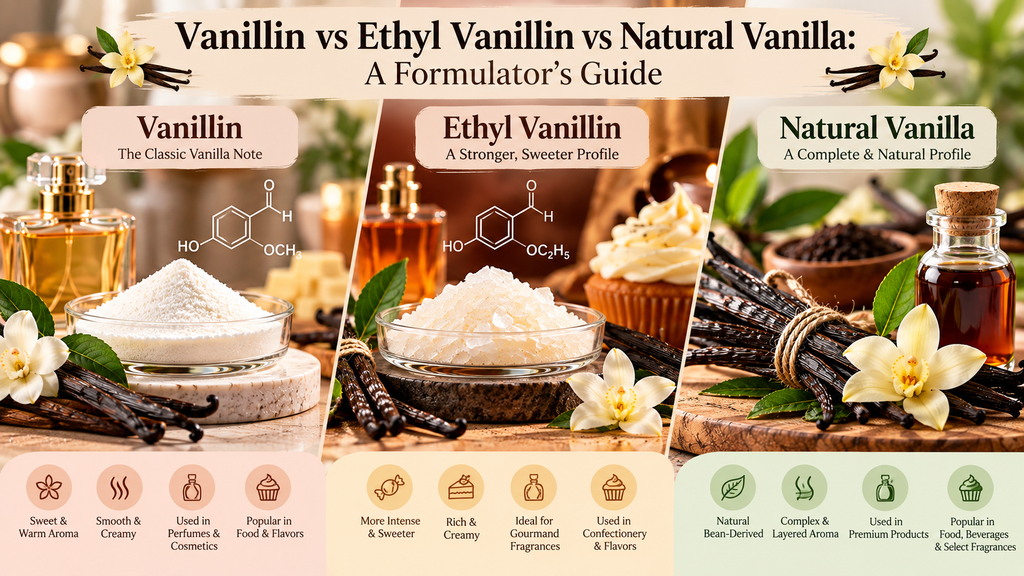
Ethyl vanillin is a compound related to vanillin. Its chemical structure is similar, but it has a different substituent group, which contributes to differences in its sensory character.
Ethyl vanillin is generally described as more intense than vanillin, with a sweeter and creamier impression. Its strength can vary depending on the application, so formulators should evaluate it in the actual product rather than rely on a fixed potency ratio.
Aroma and Flavor Profile
Ethyl vanillin is often described as:
- Strong and sweet
- Creamy and rich
- Candy-like or dessert-like
- Warm, with a pronounced vanilla impression
Because of its intensity, a small amount may have a noticeable effect on the overall profile. Too much can make a formulation feel overly sweet or unbalanced.
Common Applications of Ethyl Vanillin
Ethyl vanillin may be considered for:
- Strong vanilla fragrance accords
- Gourmand and dessert-inspired perfumes
- Soap and personal care fragrance
- Confectionery and selected flavor applications
- Formulations where a more prominent vanilla note is required
Its suitability depends on the product category, local regulations, ingredient specifications, and the desired sensory result.
What Is Natural Vanilla?
Natural vanilla usually refers to material obtained from vanilla beans, such as vanilla extract, vanilla paste, or other vanilla preparations. Unlike a single aroma compound, natural vanilla contains a mixture of aromatic substances.
Vanillin is the major aroma compound associated with vanilla beans, but other compounds contribute to the fuller aroma. This is why natural vanilla can have more depth and variation than a formulation built around vanillin alone.
Aroma and Flavor Profile
Natural vanilla may offer:
- A familiar vanilla aroma
- Warm, sweet, and creamy notes
- Additional woody, fruity, or balsamic nuances
- A more layered profile than a single isolated compound
Its exact character can vary with the vanilla source, processing method, extract concentration, and product quality.
Common Applications of Natural Vanilla
Natural vanilla is commonly used in:
- Premium food and beverage products
- Bakery and dessert applications
- Confectionery
- Dairy-style products
- Selected fragrance and personal care products
Natural vanilla may be preferred when the formulation calls for a bean-derived ingredient or a more complex vanilla profile. However, natural sourcing does not automatically mean that the ingredient is suitable for every formulation or labeling claim.
Vanillin vs Ethyl Vanillin vs Natural Vanilla: Key Differences
| Feature | Vanillin | Ethyl Vanillin | Natural Vanilla |
| Ingredient type | Single aroma compound | Single aroma compound related to vanillin | Vanilla bean extract or preparation |
| Source | May be produced through synthetic or natural-source processes | Generally produced synthetically | Obtained from vanilla beans |
| Aroma character | Familiar, warm, smooth vanilla | More intense, sweet, creamy vanilla | Layered vanilla profile with additional nuances |
| Relative intensity | Baseline for comparison | Often more intense than vanillin | Depends on the extract and concentration |
| Profile complexity | Focused vanilla note | Focused, stronger vanilla note | More complex mixture of aroma compounds |
| Formulation use | Vanilla body and warmth | Stronger vanilla impact | Bean-derived character and added complexity |
| Key consideration | Source and grade | Dosage and balance | Extract strength, consistency, and sourcing |
The comparison is a general guide. Actual performance depends on ingredient grade, concentration, formulation, processing conditions, and the finished product.
How to Choose the Right Vanilla Ingredient
There is no single option that works best for every formulation. The right choice depends on what the product needs to achieve.
1. Choose Vanillin for a Familiar Vanilla Note
Vanillin may be suitable when you want a recognizable vanilla character that blends smoothly with other ingredients.
It can be considered for:
- Warm fragrance accords
- Vanilla body-care fragrances
- Chocolate and bakery flavor profiles
- Formulations where a moderate vanilla note is required
It is also useful as a building block in blends where other materials provide additional sweetness, creaminess, or complexity.
2. Consider Ethyl Vanillin for a More Intense Profile
Ethyl vanillin may be useful when a formulation requires a stronger vanilla impression.
It can be considered for:
- Bold gourmand fragrance directions
- Sweet, creamy fragrance accords
- Flavor systems requiring a more pronounced vanilla character
Start with controlled trials and adjust the level gradually. Because ethyl vanillin can be more intense than vanillin, a direct one-to-one replacement may change the balance of the formula.
3. Choose Natural Vanilla for Bean-Derived Complexity
Natural vanilla may be appropriate when the product brief calls for a vanilla bean extract or a more layered vanilla profile.
It can be considered for:
- Premium food products
- Products emphasizing vanilla bean character
- Formulations where source and ingredient declaration are important
Natural vanilla extracts can vary in strength and composition, so the formulator should review the supplier’s specification and test the material in the intended product.
Formulation Considerations
Selecting a vanilla ingredient involves more than comparing its aroma. Formulators should consider the product base, processing conditions, stability, and final sensory profile.
Solubility and Product Base
Check how the ingredient behaves in the intended base. A fragrance concentrate, water-based product, oil-based product, and food matrix may require different preparation and incorporation methods.
Review the supplier’s technical information for solubility, recommended handling, and compatibility before production.
Dosage and Sensory Balance
Begin with small laboratory trials. Evaluate the ingredient at different levels and compare the results in the finished product.
For fragrance, assess how the vanilla note interacts with the other materials and how it develops over time. For flavor applications, evaluate the aroma and taste within the actual food or beverage matrix.
Color and Appearance
Vanilla-related materials may affect the color of some finished products. The impact can depend on the ingredient, concentration, formula, and storage conditions. Test the final product for any unwanted color change, especially when a light or white appearance is important.
Stability and Storage
Follow the supplier’s recommended storage conditions and packaging guidance. Evaluate the ingredient and finished formulation under the expected storage conditions, including exposure to light, heat, and air where relevant.
Regulatory and Labeling Requirements
The requirements for fragrance ingredients, food flavors, cosmetics, and product labels can differ by country and product category.
For example, U.S. regulations define specific requirements for products labeled as vanilla extract and certain vanilla-vanillin products. Other markets may have different requirements. Confirm the applicable rules before making claims such as “natural vanilla,” “vanilla extract,” or “natural flavor.”
Can Vanillin, Ethyl Vanillin, and Natural Vanilla Be Used Together?
Yes, depending on the product category and the formulation requirements, a formulator may combine vanilla ingredients to create a specific profile.
For example:
- Vanillin can provide a familiar vanilla foundation.
- Ethyl vanillin can increase the perceived intensity of the vanilla note.
- Natural vanilla can contribute additional bean-derived aroma complexity.
The blend should be developed through testing rather than assumed ratios. Evaluate the aroma or flavor in the finished product and confirm that all ingredients are permitted for the intended use.
Frequently Asked Questions
1. Is ethyl vanillin stronger than vanillin?
Ethyl vanillin is generally considered more intense than vanillin, but the exact difference depends on the formulation and application. It is best to compare them through controlled trials rather than use a universal potency multiplier.
2. Is natural vanilla the same as vanillin?
No. Vanillin is a single aroma compound, while natural vanilla extract contains vanillin along with other aromatic compounds. This broader composition can create a more layered profile.
3. Is ethyl vanillin natural?
Ethyl vanillin is generally produced synthetically and is not the same as vanilla bean extract. Check the supplier’s documentation and the applicable market’s ingredient-claim requirements before making a natural-origin claim.
4. Which ingredient is used in perfumes?
Vanillin and ethyl vanillin are both used in fragrance development. Natural vanilla materials may also be used where their profile and specifications suit the formulation. The selection depends on the desired scent, product base, and performance requirements.
5. Can vanillin and ethyl vanillin be substituted at the same level?
Not automatically. Ethyl vanillin is often more intense, so replacing vanillin at the same concentration may change the fragrance or flavor balance. Conduct small-scale trials and adjust based on the finished product.
6. Does natural vanilla always have a stronger aroma?
No. Its aroma strength depends on the type of vanilla material, extract concentration, processing, and formulation. Natural vanilla may offer more complexity, but it is not always stronger than a concentrated aroma compound.
Conclusion
Vanillin, ethyl vanillin, and natural vanilla each serve different formulation needs.
Vanillin offers a familiar, warm vanilla note. Ethyl vanillin can provide a more intense and sweeter vanilla impression. Natural vanilla brings a broader aroma profile from vanilla beans, with character that can vary by source and extract.
For formulators, the practical approach is to define the target profile, review the ingredient specifications, and test each option in the actual product base. The best selection is the one that delivers the required sensory result while meeting the product’s technical, sourcing, and regulatory requirements.