
Flavours and fragrances are blends of aromatic ingredients designed to create taste or scent. Flavours are made to be eaten and must meet food-safety rules. Fragrances are made to be smelled in perfumes, cosmetics and household products. Both rely on aroma chemicals, essential oils and natural extracts, sourced from specialist suppliers.
why flavours and fragrances matter
Every product people taste or smell owes part of its appeal to flavours and fragrances. The vanilla note in a protein bar, the citrus lift in a dish soap and the fresh scent of a shampoo are all carefully engineered.
The flavours and fragrances (F&F) industry supplies these sensory ingredients to food, beverage, personal care, home care and pharmaceutical manufacturers. For many brands, taste or scent is the main reason a customer buys again.
This guide explains how flavours differ from fragrances, which ingredients they are built from, where they are used, and how manufacturers can source them from a reliable flavour ingredients supplier or essential oils supplier.
What is the difference between flavours and fragrances?
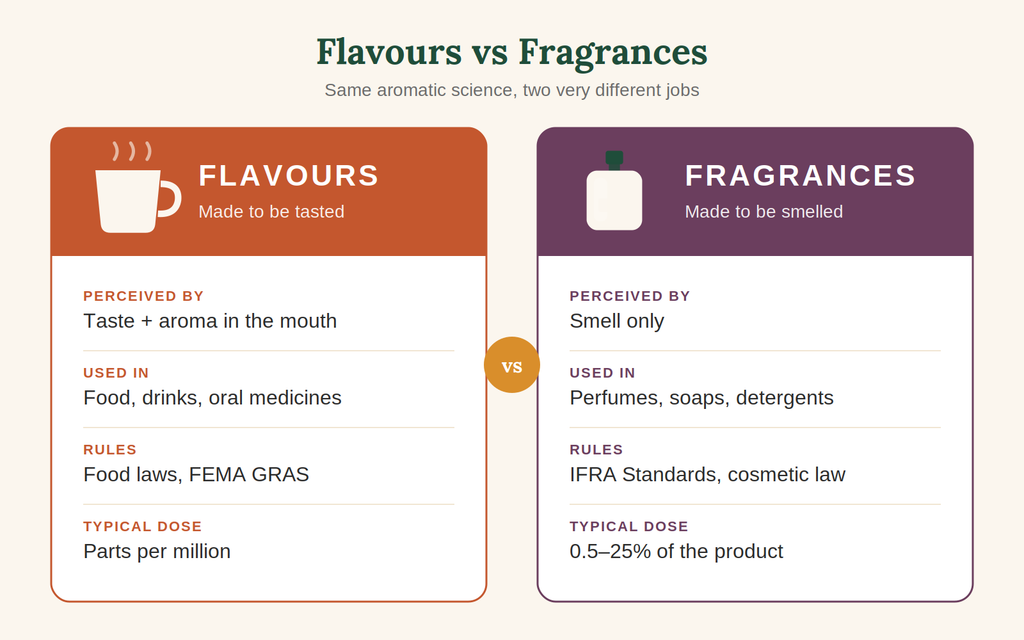
The core difference is how the product is experienced. A flavour is consumed and perceived through taste and retronasal smell. A fragrance is applied or released and perceived only through the nose.
This single distinction drives different regulations, ingredient choices and testing requirements.
| Aspect | Flavours | Fragrances |
|---|---|---|
| Purpose | Create or enhance taste in ingestible products | Create or enhance scent in non-ingestible products |
| How it is perceived | Taste buds plus aroma released in the mouth | Olfaction only |
| Typical products | Beverages, snacks, dairy, confectionery, oral medicines | Perfumes, soaps, detergents, candles, lotions |
| Key regulations | Food laws such as EU Regulation 1334/2008, FDA rules and FEMA GRAS status | IFRA Standards, cosmetic regulations such as EU 1223/2009, allergen labelling |
| Ingredient palette | Narrower, limited to food-approved substances | Wider, includes many synthetic aroma chemicals not approved for food |
| Dosage | Usually low, often parts per million | Higher, often 0.5–25% depending on product |
| Stability concerns | Heat, pH and processing conditions | Skin contact, light, oxidation and product base |
In short, every flavour ingredient must be safe to eat, while fragrance ingredients must be safe for skin contact and inhalation at the levels used. Some materials, such as vanillin or limonene, appear in both, but grade and purity requirements differ.
Key ingredients in flavours and fragrances
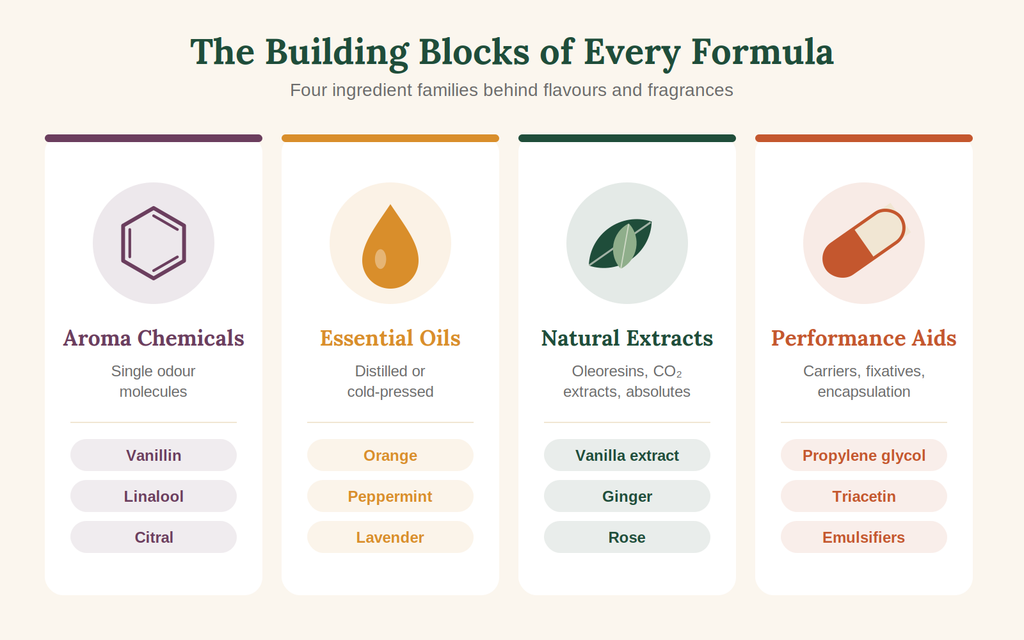
Most flavour and fragrance formulas combine four ingredient families. Perfumers and flavourists blend dozens of them to build a single profile.
Aroma chemicals
Aroma chemicals are individual odour-active molecules, either synthesised or isolated from natural sources. They give formulators precise, consistent and cost-effective building blocks.
Common examples include vanillin (vanilla), linalool (floral, lavender), citral (lemon), benzaldehyde (cherry, almond), ethyl maltol (caramel) and hedione (fresh jasmine). Aroma chemicals are classed as nature-identical or artificial in flavours, and they form the backbone of most modern fragrances.
Essential oils
Essential oils are concentrated volatile oils extracted from plants by steam distillation or cold pressing. Orange, lemon, peppermint, eucalyptus, lavender, clove and patchouli oils are among the most traded.
They deliver complex, natural profiles and support clean-label claims. Because crop quality varies by season and origin, choosing an experienced essential oils supplier is critical for batch consistency.
Natural extracts and absolutes
Oleoresins, CO2 extracts, tinctures and absolutes capture fuller aromas than distillation alone. Vanilla extract, ginger oleoresin, rose absolute and coffee extract are typical examples used in premium products.
Flavour and fragrance ingredients for performance
Finished formulas also need supporting materials. These include carriers and solvents (propylene glycol, ethanol, triacetin), fixatives that slow evaporation, emulsifiers for beverages, and encapsulation systems that protect volatile notes during processing or release them on use.
Industrial applications of flavours and fragrances
Flavours and fragrances are used wherever sensory experience shapes buying decisions. Each sector has its own technical demands.
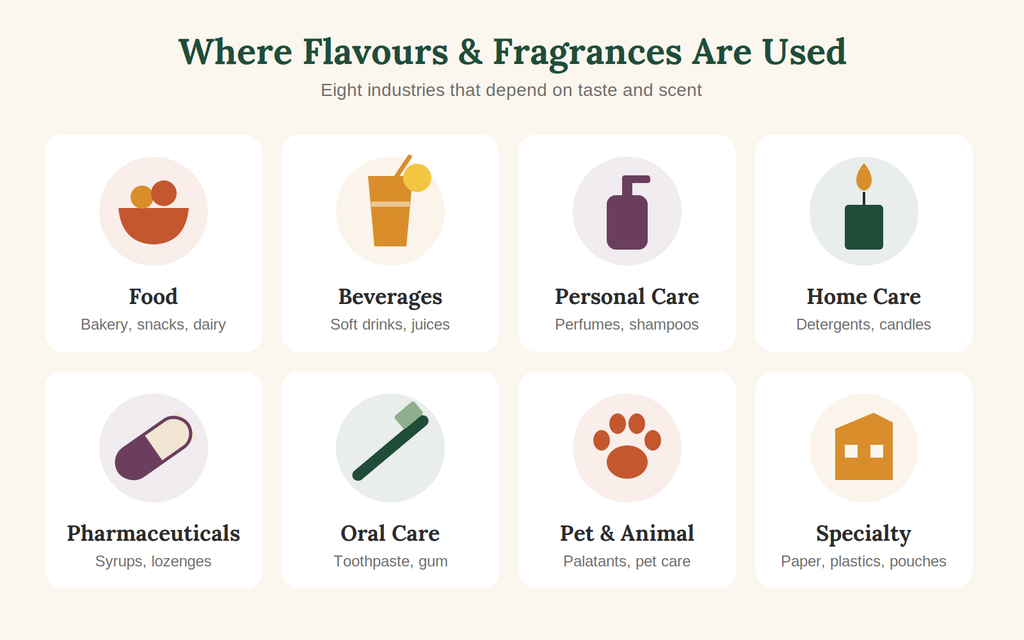
| Industry | Typical applications | Key ingredient needs |
|---|---|---|
| Food | Bakery, snacks, dairy, confectionery, savoury seasonings | Heat-stable flavours, natural extracts, encapsulated flavours |
| Beverages | Soft drinks, juices, energy drinks, alcoholic drinks | Water-soluble emulsions, citrus essential oils, clean-label flavours |
| Personal care | Perfumes, shampoos, deodorants, skin creams | IFRA-compliant fragrance ingredients, low-allergen aroma chemicals |
| Home care | Detergents, fabric softeners, air fresheners, candles | Long-lasting, bleach- and alkali-stable fragrances |
| Pharmaceuticals | Syrups, chewable tablets, lozenges | Masking flavours for bitter actives, pharma-grade documentation |
| Oral care | Toothpaste, mouthwash, chewing gum | Mint oils, menthol, cooling agents |
| Animal nutrition and pet care | Feed palatants, pet shampoos | Palatability enhancers, mild fragrances |
| Tobacco alternatives and others | Nicotine pouches, e-liquids, paper and plastics | Application-specific flavour or scent systems |
The same note can behave differently across these bases. A lemon fragrance that is stable in a shower gel may degrade in a bleach cleaner, so suppliers must test in the actual product matrix.
How to choose a reliable flavour and fragrance ingredients supplier
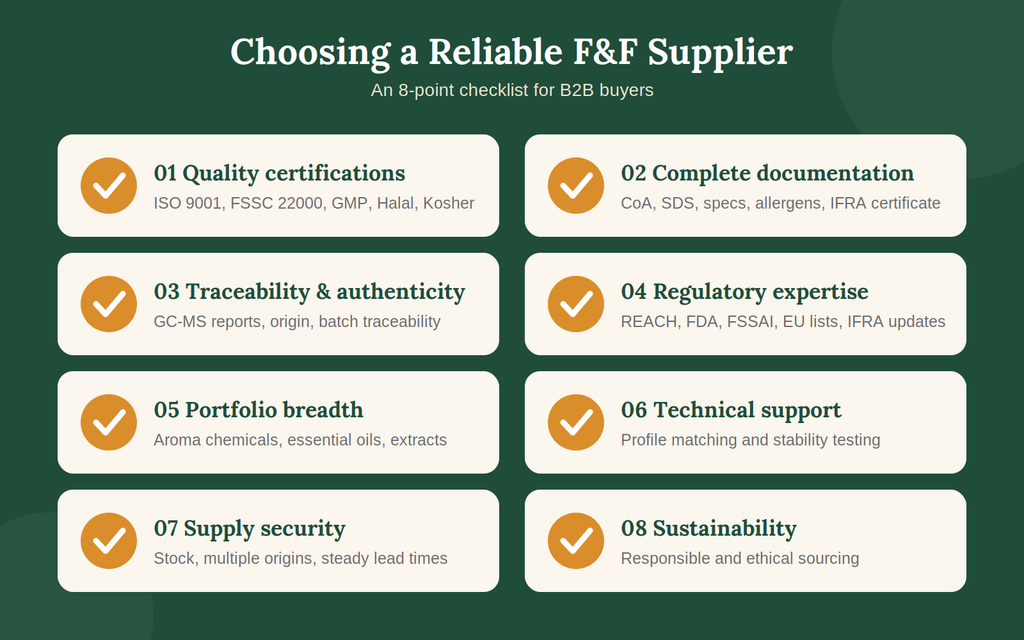
The right supplier protects product quality, regulatory compliance and supply continuity. Use these criteria when evaluating a flavour ingredients supplier, aroma chemicals distributor or essential oils supplier.
- Quality certifications. Look for ISO 9001, FSSC 22000 or ISO 22000 for food, GMP for pharma, and Halal or Kosher where your market needs them.
- Complete documentation. Every lot should come with a Certificate of Analysis, Safety Data Sheet, specification sheet, allergen declaration and, for fragrances, an IFRA Certificate of Conformity.
- Traceability and authenticity. Essential oils are often adulterated. Ask for GC-MS reports, country of origin and batch traceability back to the producer.
- Regulatory expertise. A good supplier tracks REACH, FDA, FSSAI, EU flavour lists and IFRA amendments, and alerts you before a change affects your formula.
- Portfolio breadth. One partner covering aroma chemicals, essential oils and natural extracts simplifies purchasing and reduces vendor risk.
- Technical and application support. Labs that can match a target profile, test stability in your base and suggest cost-optimised alternatives save months of development.
- Supply security. Ask about inventory levels, multiple sourcing origins, lead times and how they handled past crop failures or price spikes.
- Sustainability and ethics. Responsible sourcing, fair-trade programmes and lower-carbon production matter increasingly to brand owners and regulators.
Supplier checklist: request samples and full documentation, audit or review the facility, run a pilot batch in your product, then agree on specifications, minimum order quantities and change-notification terms before scaling up.
Trends shaping the flavours and fragrances industry
Several shifts are changing what manufacturers ask of their suppliers:
- Natural and clean label. Demand for natural flavours, essential oils and upcycled extracts continues to grow in food and personal care.
- Biotech ingredients. Fermentation and biocatalysis now produce natural-grade vanillin, nootkatone and other molecules with more stable supply.
- Allergen and safety pressure. Expanded EU fragrance allergen labelling and IFRA updates are pushing reformulation toward safer aroma chemicals.
- Sugar and salt reduction. Flavour modulators help brands cut sugar and sodium without losing taste.
- Functional and wellness scents. Mood-focused fragrances and botanical profiles are rising in home and personal care.
- Digital formulation. AI-assisted tools speed up profile matching and cost optimisation, but still depend on good raw materials.
Frequently asked questions
What are flavours and fragrances?
Flavours and fragrances are formulated blends of aromatic ingredients. Flavours add taste to food, drinks and medicines, while fragrances add scent to perfumes, cosmetics and household products.
What are aroma chemicals used for?
Aroma chemicals are single odour molecules used to build flavour and fragrance formulas. They provide consistent, cost-effective notes such as vanilla, citrus, floral or fruity.
Are essential oils flavours or fragrances?
Essential oils can be both. Food-grade oils like peppermint and orange are used in flavours, while oils like lavender and patchouli are mostly used in fragrances.
Can fragrance ingredients be used in food?
Only if they are approved for food use and supplied in food grade. Many fragrance ingredients are not permitted in food at all.
What documents should a flavour or fragrance supplier provide?
At minimum: a Certificate of Analysis, Safety Data Sheet, specification, allergen statement and, for fragrances, an IFRA certificate. Food and pharma buyers also need regulatory and origin statements.
Conclusion
Flavours and fragrances may make up a small share of a formula, but they often decide whether a product succeeds. Understanding the difference between flavours and fragrances, and the roles of aroma chemicals, essential oils and natural extracts, helps manufacturers brief suppliers clearly and avoid costly reformulation.
The best results come from a supplier that combines a broad, high-quality portfolio with documentation, regulatory knowledge and dependable supply.