
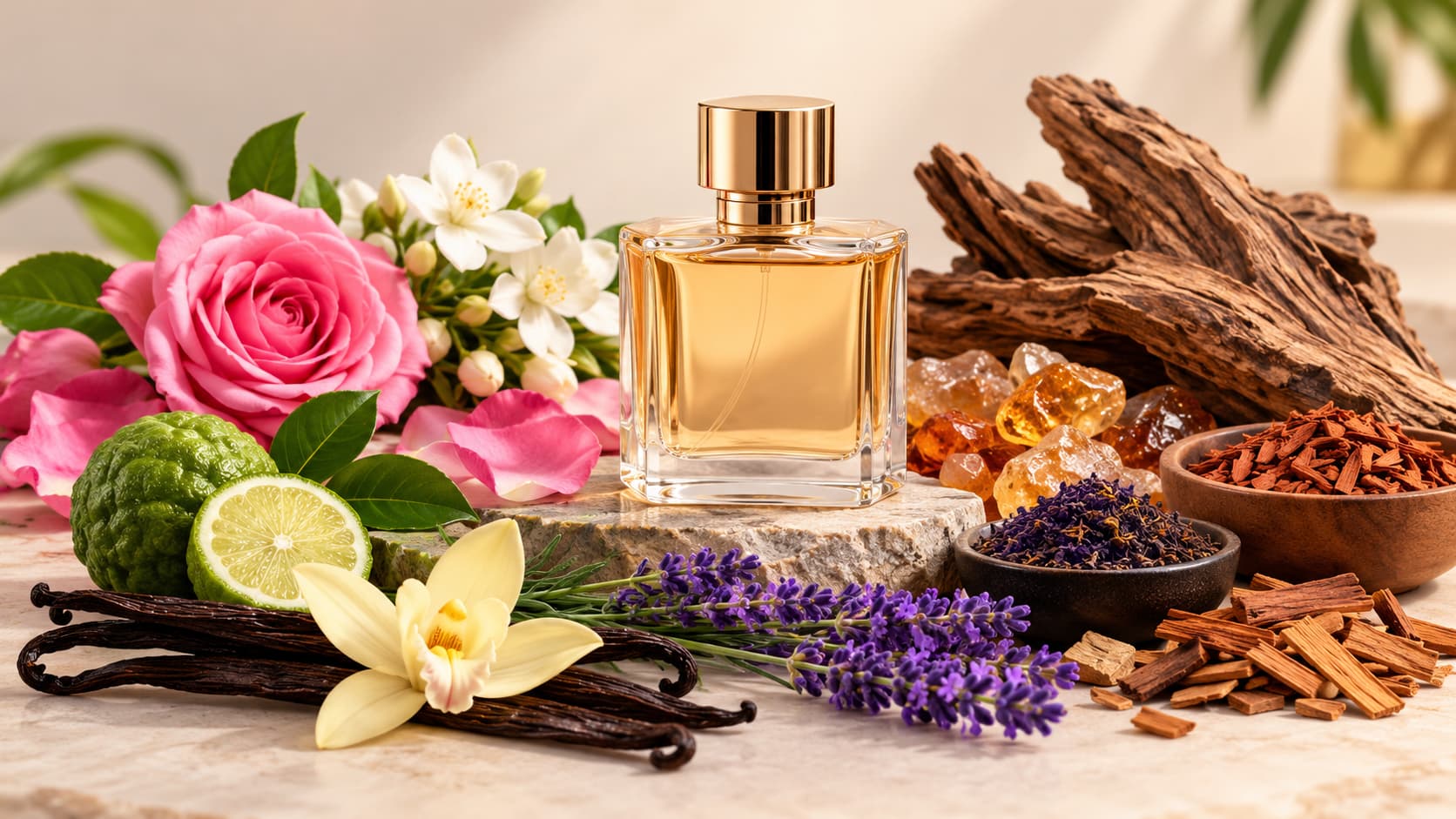
According to 2026 statistics, some of the most popular perfume ingredients include bergamot, essential oils of citrus fruits, rose and jasmine, sandalwood and cedarwood, vanilla, musks, amber, oud and patchouli, and innovative aroma chemicals. Many of the luxurious fragrances have a mixture of natural substances and aroma chemicals to achieve the desired balance.
This guide is dedicated to explaining what perfume ingredients are, the most popular materials used today, how the notes of perfume work, and how manufacturers can source quality fragrance raw materials.
What Are Perfume Ingredients?
Perfume ingredients are the aromatic substances and the agents that mix and thus lead to the creation of a fragrance. Normal perfume has fragrance concentrate, which consists of various aromas dissolved in alcohol or another carrier.
| Ingredient type | What it is | Role in a perfume |
| Fragrance materials | The umbrella term for every scented material used, natural or synthetic | Create the overall scent |
| Essential oils | Natural oils extracted from flowers, leaves, peels, woods or roots by distillation or pressing | Add natural depth, character and richness |
| Aroma chemicals | Single scent molecules, either made in a lab or isolated from natural sources | Add freshness, diffusion, consistency and longevity |
| Alcohol | Usually perfumers’ (denatured) ethanol | Dilutes the concentrate and helps the scent spread on the skin |
| Solvents and carriers | Materials such as dipropylene glycol (DPG) or isopropyl myristate (IPM) | Dissolve and dilute ingredients, especially in oils and non-alcohol products |
How ingredients work together: A perfumer makes a fragrance as if it were a recipe. Light fresh ingredients form the first impression, floral and spicy substances create the heart, and heavier wood materials and resins form the base of the scent. Aroma chemicals fill in the gaps in scents, enhancing freshness or softening unpleasant parts of the fragrance and making it last longer.
Most Popular Perfume Ingredients in 2026
These eight ingredient groups appear in a large share of today’s fine fragrances, personal care, and home care scents.
Citrus and Bergamot Oil
What it smells like: clean, bright, a bit bitter, and effervescent.
Bergamot, lemon, orange, grapefruit, and tangerine oils are standard top notes in perfumes. Bergamot is a favourite ingredient because of its clean scent and its hint of floral character. Due to its frequent use by perfumers, one can easily find it in colognes, light perfumes, and many floral and oriental compositions. Perfumers usually use bergapten-free (FCF) bergamot oil for the avoidance of skin sensitivity problems when in contact with sunlight.
Explore our citrus aroma chemicals.
Rose and Jasmine
What it smells like: Rose is deep, smooth, and romantic, while jasmine is sweet, strong, and a little fruity.
The pair of flowers is represented in floral perfumery. Natural rose oil and jasmine absolute are very valuable fragrance materials; therefore, they are usually used together with floral aroma chemicals while creating rich and reasonably priced floral fragrances. See our rose oil and floral aroma chemicals.
Sandal and Cedar
What it smells like: Sandalwood conveys a smooth and milky scent, while cedarwood is characterised by a dry scent like that of a pencil.
Woody notes enhance the overall warmth in fragrances. Due to the cost and low availability of natural sandalwood, sandalwood aroma chemicals are frequently used to create its soft scent. Cedarwood is much cheaper and also can be found in masculine and unisex fragrances. Explore our woody aroma chemicals.
Vanilla
What it smells like: sweet, soft, warm, and soothing.
Vanilla is among the most popular notes in perfumes and an important component of gourmand fragrances. The choice between natural vanilla extracts, vanillin, and ethyl vanillin can depend on the strength, cost, or effects needed. Learn more in our guide to vanillin vs ethyl vanillin vs natural vanilla.
Musk elements
What it smells like: gentle, pure, skin-like, and powdery.
Modern perfumery employs synthetic musks but not animal musks. “White musk” delivers purity and comfort and has a second-skin effect and makes the scent last longer. It is utilised in nearly each category of fragrance, including perfumery and washing products.
Amber and materials resembling amber
What it smells like: warm, resinous, sweet, and a little salty or woody.
In perfumery “amber” stands not for the fossil resin but for the accord itself. It is formed of labdanum, benzoin, vanilla, and chemicals that produce an aroma similar to ambergris, for example, ambroxan, which brings the mineral temperature of ambergris closer to the scent.
Oud and Patchouli
What it smells like: Oud is characterised by a deep, smoky, and leathery scent, while the scent of patchouli is earthy, dark, and slightly sweet.
Oud is one of the rarest ingredients in perfume and one of the mainstream elements in the Middle East and luxury fragrances. Because of the fact that natural oud is very expensive to get, fragrance manufacturers resort to scent chemicals to create appropriate oud fragrances. Patchouli is another well-known base note used to make both chypre and oriental perfumery.
Modern Aroma Chemicals
What it smells like: Depends on the particular molecules, from fresh, airy smells to woody, floral, or marine scents.
Aromatic chemicals are crucial in perfumery nowadays. Some of the widely used examples are Hedione (fresh and light jasmine note), Iso E Super (elegant wood note), Ambroxan (warm note resembling amber), and Calone (fresh marine note). On top of that, they make it possible for manufacturers to create new effects and ensure a more stable quality.
Natural vs Synthetic Perfume Ingredients
The majority of modern perfumes use a combination of the two. Natural aroma ingredients contribute depth and complexity, while synthetic aroma chemicals provide uniformity, new scent effects, and longer-lasting fragrances.
| Factor | Natural ingredients | Synthetic aroma chemicals |
| Source | Plants, flowers, woods, resins and fruits | Made in a lab or isolated from natural materials |
| Scent profile | Complex, layered and slightly variable | Clean, precise and consistent |
| Consistency | Can change with harvest, region and season | Same quality from batch to batch |
| Cost | Often higher, especially for rare materials | Usually more affordable |
| Availability | Can be limited by climate or scarcity | Stable and reliable supply |
| Sustainability | Depends on farming and harvesting practices. | Can reduce pressure on rare or endangered plants and animals |
| Examples | Bergamot oil, rose oil, patchouli oil, vetiver oil | Hedione, Iso E Super, Ambroxan, vanillin, white musks |
Natural does not mean safe, just as synthetic does not mean poor. Both materials have to be used within the safety limits established by the International Fragrance Association (IFRA).
Understanding Top, Middle and Base Notes
A perfume changes as it dries on the skin. Perfumers describe this in three layers, known as the fragrance pyramid.
| Note | When you smell it | How long does it last | Common ingredients |
| Top notes | First impression, right after spraying | About 5 to 30 minutes | Bergamot, lemon, orange, grapefruit, mint, pink pepper |
| Middle (heart) notes | After the top notes fade, the main character of the perfume | About 30 minutes to a few hours | Rose, jasmine, lavender, neroli, spices |
| Base notes | the final, deepest layer that stays on the skin | Several hours or longer | Sandalwood, cedarwood, vanilla, musk, amber, oud, patchouli, vetiver |
Which Perfume Ingredients Help a Fragrance Last Longer?
Heavy base notes and fixatives are important for the long-lasting quality of a fragrance because they take their time to evaporate and also slow down the rise of the lighter notes above them.
Ingredients that improve longevity include:
- Musks: Synthetic musks happen to be some of the materials that last the longest, leaving a delicate skin scent.
- Amber materials: Ambroxan and labdanum create warmth and notable longevity.
- Woods: The use of sandalwood, cedarwood, and vetiver as base notes prolongs the scent’s life.
- Resins and balsams: Benzoin, tolu, and Peru balsam can be regarded as natural fixatives.
- Vanilla and vanillin: Sweet notes allow the base notes to remain longer on the skin.
- Oud and patchouli: Intense materials having high staying power.
The concentration is also important: the higher the concentration of a fragrance’s oil, the longer it lasts:
| Type | Approximate fragrance oil concentration |
| Parfum/extract | 20% – 30% |
| Eau de parfum (EDP) | 15% – 20% |
| Eau de toilette (EDT) | 5% – 15% |
| Eau de cologne (EDC) | 2% – 5% |
Ranges vary between brands.
How to Choose the Right Perfume Ingredients for Your Fragrance
- Define the scent profile: Choose the type of fragrance (fresh, floral, woody, amber, or gourmand) and the mood you want to create.
- Know the end product: Fine fragrance, body care, soap, detergent, and candles have different properties. An ingredient that is fine for perfume may spoil your soap.
- Balance top, middle, and base notes: Ensure a fresh opening, a clear heart, and a lasting base.
- Mix natural and synthetic materials: Use naturals to add depth and aroma chemicals for efficacy and consistency.
- Check stability: Some ingredients, such as vanillin, may cause discolouration, while citrus oils may oxidise.
- Follow IFRA limits and local regulations: Check limits for use and allergen labelling of your product, depending on the target market.
- Consider cost and supply: Some natural materials, such as oud, rose, or sandalwood, are very rare and hard to get.
- Test before scaling up: Take time to test your product quality before making large batches.
Perfume Ingredients for Different Fragrance Categories
| Fragrance category | Scent character | Key fragrance ingredients |
| Fresh/citrus | Bright, clean and energising | Bergamot, lemon, grapefruit, neroli, citrus aroma chemicals |
| Floral | Romantic, soft and feminine | Rose, jasmine, tuberose, lily of the valley, Hedione |
| Woody | Warm, dry and elegant | Sandalwood, cedarwood, vetiver, Iso E Super |
| Amber / Oriental | Rich, warm and sensual | Amber accords, labdanum, benzoin, vanilla, spices |
| Gourmand | Sweet, edible and comforting | Vanilla, caramel, coffee, chocolate, praline, tonka bean |
| Aquatic / marine | Airy, salty and cool | Calone, marine aroma chemicals, citrus, light musks |
| Oud / leather | Deep, smoky and luxurious | Oud, saffron, leather accords, patchouli, rose |
| Fougère / aromatic | Herbal, fresh and classic | Lavender, coumarin, oak moss accord, geranium |
You can also explore our fine fragrance ingredients for perfume development.
How to Source Quality Perfume Ingredients for Manufacturing
The nature of the raw materials determines the efficiency, uniformity, and safety of the final product. Here is what to look for in a supplier:
- Genuine products from trusted brands: You should deal only with those manufacturers who are the genuine distributors of authentic products to save yourself from hazardous, contaminated materials.
- Complete documentation: It is a good idea to make sure the supplier can provide you with the CoA, SDS, and IFRA documents for every component.
- Regulatory compliance: The products must comply with IFRA, REACH regulations, and the requirements of the markets you sell in.
- Batch-to-batch consistency: Batch consistency is of particular importance when it comes to natural oils, since they can be completely different from one harvest to another.
- Samples for testing: A trustworthy supplier will always supply a few testing samples so you can test the composition you are going to work on.
- Reliable supply and logistics: Check stock availability, delivery time, and bulk order supply opportunities.
- Technical support: Look for a supplier that has a professional technical team in place.
Perfume Ingredients Trends to Watch in 2026
- Gourmands grow up: Vanilla takes a prime position in the scent world, yet sweet notes are moving towards savoury and textured ones such as pistachio, rice, milk accords and a touch of salt.
- Saffron and spices: Saffron is fast becoming a key player, bringing warmth and richness to floral and wood scents.
- Juicy berries and fruit: Raspberry, strawberry and other juicy fruity and jam notes remain on the market as well.
- Clean skin perfumes: A wide range of soft musks combined with airy woods and ambers is used to produce gentle ‘your skin but better’ fragrances.
- Modern oud: Oud is interpreted in lighter, smoother and more wearable blends now.
- Unisex fragrances are easy to layer: Simple and flexible perfumes comprising musks, woods, citruses and ambers work for the new layering trend.
- Sustainable and biotech ingredients: Brands want traceable natural ingredients and those made using biotechnology to secure a constant supply and lessen pressure on natural resources.
- Higher-quality ingredients: Customers are willing to spend money on what goes into their fragrance, so the surge in demand for premium natural perfumes and advanced aroma chemicals is expected.
Frequently Asked Questions
What are the most common perfume ingredients?
The most popularly used perfume ingredients include bergamot, rose, jasmine, sandalwood, vanilla, musks, amber, and aroma chemicals diluted in alcohol.
Which ingredients make perfume smell stronger?
Amber materials, woods, oud, high-impact aroma chemicals, and high concentrations of the essence create more concentrated perfumes.
What is the difference between natural and synthetic perfume ingredients?
Natural ingredients are derived from nature, while synthetic aroma chemicals are produced in the laboratory. Naturals provide complexity while synthetics provide consistency.
Which perfume ingredients help improve longevity?
Base notes such as musk, amber, sandalwood, vetiver, vanilla, patchouli, and oud provide a longer-lasting scent.
What are aroma chemicals used for in perfumes?
Aroma chemicals are used to produce new scents, replace rare naturals, preserve quality, and improve the strength and longevity of perfumes.
How do manufacturers choose fragrance raw materials?
They choose the ingredients based on scent, product, shelf life, and cost and make sample batches.
Are natural perfume ingredients always safer than synthetic ones?
No. Natural oils may also cause allergies or be irritating. All fragrance ingredients must be used within IFRA safety limits.
Conclusion
Good scents are created with the help of the right perfume ingredients. Citrus oils make the first impression, florals create the main note, and woods, musk, vanilla, and oud give longevity. The presence of modern aroma chemicals makes it easier to achieve the desired quality. In 2026 all that is needed to be fashionable are savoury flavours, saffron, clean skin scents, and environmentally friendly materials.
Contact P. P. Sheth for genuine aroma chemicals, essential oils, and fragrance ingredients from trusted global brands.