
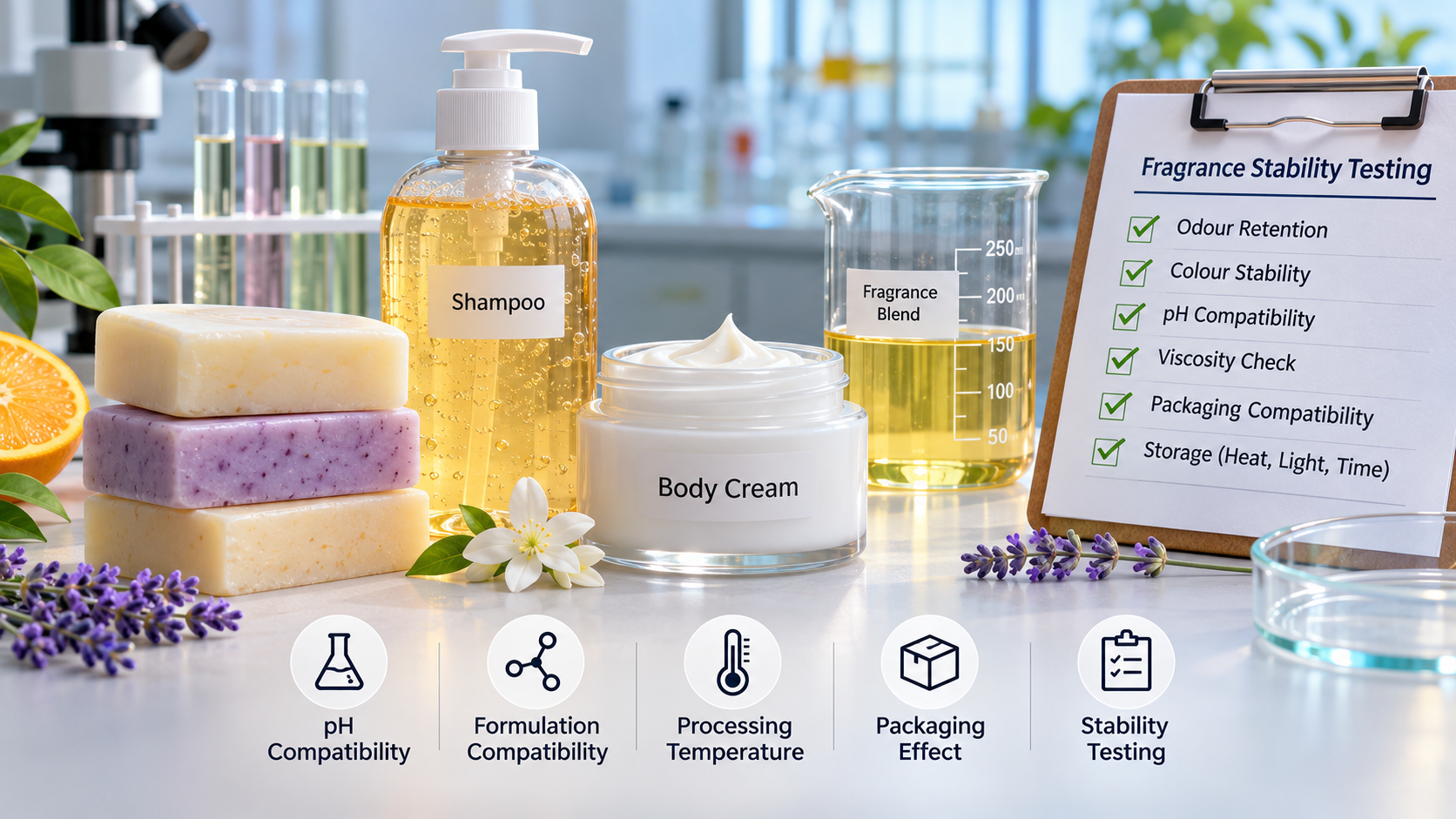
Fragrance stability in soaps, shampoos and cosmetic formulations is essential for maintaining consistent scent, colour and product quality during storage. A product may smell appealing immediately after manufacturing but develop a weaker or different odour over time. For personal care manufacturers, understanding fragrance compatibility, formulation conditions and stability testing helps reduce these problems before production.
Choose fragrance materials that are compatible with the product base, assess them at an appropriate and compliant concentration, add them at a suitable process stage, and test the finished formula in its intended packaging. Keep an unfragranced control so you can distinguish fragrance-related changes from problems in the base itself.
Why Fragrance Behaves Differently in Each Product Base
A fragrance can contain components with different solubility, volatility and chemical reactivity. Their behaviour changes with pH, surfactants, oil–water balance, processing conditions and packaging. A fragrance that works in a mildly acidic shampoo may not behave the same way in a traditional alkaline soap.
| Product Base | Main Formulation Challenge | What to Monitor |
| Traditional bar soap | High alkalinity; processing conditions vary | Odour shift, fading and colour change |
| Shampoo and body wash | Water-rich surfactant systems | Haze, viscosity change, separation and wash-time odour |
| Creams and lotions | Oil-in-water or water-in-oil emulsions | Odour drift, viscosity change and emulsion separation |
| Clear gels and toners | Fragrance must remain adequately solubilised | Cloudiness, droplets or sediment |
For example, a vanilla-style fragrance may smell acceptable in one base yet cause a pale soap bar to darken. This is an application-specific possibility, not a prediction that every vanillin-containing fragrance will discolour.
Choose Fragrance Ingredients for Stability, Not Aroma Alone
Use these questions when screening a new fragrance or individual aroma material:
- pH compatibility: Has the material or fragrance blend been evaluated in a base with a similar pH and ingredient system?
- Oxidation sensitivity: Could exposure to air, heat or light change the odour or appearance? Certain terpene-rich materials warrant particular attention.
- Colour behaviour: Could the fragrance or its components contribute to yellowing or browning? Vanillin-related discoloration is one reason to run colour trials.
- Solubility: Will the fragrance remain dispersed or solubilised in a clear surfactant or aqueous system without causing haze or oil droplets?
- Odour profile over time: Does the balance of top, heart and base notes still deliver the intended character after storage and during normal product use?
Antioxidants, chelating agents or light-protective packaging can be considered where technically justified, but they do not automatically rescue an incompatible fragrance. Any supporting ingredients must also be suitable for the overall formulation and target market.
Ingredient sourcing: Formulators reviewing individual aroma chemicals should request product-specific technical information rather than assume that every natural or synthetic material has the same stability profile.
Check Compatibility, Concentration and the Addition Stage
Test the Finished Formula, Not Just the Fragrance
Prepare a small, controlled trial using the actual soap, shampoo or cosmetic base. Compare the unfragranced base with the proposed fragranced version, using the same processing and storage conditions.
Record odour, colour, clarity, pH and viscosity wherever relevant. If the fragranced sample changes but the control does not, investigate fragrance–base interactions before scaling up.
Do Not Increase Dosage Just to Compensate for Fading
The appropriate fragrance level depends on the formula, intended use, applicable restrictions and the desired sensory profile.
Adding more can worsen haze, viscosity, skin feel or separation and may exceed an applicable usage limit.
Follow the mixture supplier’s documented use recommendations, verify any applicable IFRA restriction for the finished-product category, and validate the concentration in your own trials.
Add Fragrance at a Process-Appropriate Stage
| Product | General Processing Consideration |
| Creams and lotions | Evaluate addition during a suitable cool-down stage after emulsion formation, where the process permits. |
| Shampoos and body washes | Often evaluated toward the end of mixing; select any solubilisation or premixing approach through trials. |
| Bar soaps | Use the timing and temperature appropriate to the specific hot-process, cold-process or other manufacturing method. |
These are starting considerations, not universal temperature or dosage instructions. Record the actual process conditions during each bench trial.
Troubleshoot Common Fragrance Stability Problems
When a sample fails, identify the symptom before changing the entire formula. The following checks help narrow down possible causes.
| Observed Issue | Possible Contributing Factors | Next Practical Check |
| Scent fades or changes | Volatility, oxidation, base interaction, storage conditions | Compare retained samples and controls; review heat, air and light exposure. |
| Yellowing or browning | Colour-forming ingredients or reactions in the base | Check the unfragranced control and fragrance variants under the same conditions. |
| Cloudiness in clear shampoo | Inadequate solubilisation or surfactant–fragrance incompatibility | Review fragrance level, solubiliser and surfactant system in controlled trials. |
| Viscosity drops or rises | Changes in surfactant structure or interaction with salts and fragrance | Measure viscosity before/after addition and through storage. |
| Cream or lotion separates | Emulsion sensitivity to added fragrance or other ingredients | Compare base and fragranced emulsion across appropriate temperature conditions. |
| Packaged product smells different | Container interaction, absorption or volatile loss | Test the production-intent container, closure and storage orientation. |
A change in colour or odour does not identify the cause by itself. Use the control, batch records and relevant analytical or physical tests to determine what changed.
How to Test Fragrance Stability in Soaps, Shampoos and Cosmetics
Do not assume a fragrance is stable because it passes a single short trial. Design a programme for the formula and intended market, with defined acceptance criteria before testing starts.
- Document a baseline: Record the formula version, fragrance batch, concentration, manufacturing conditions and initial appearance, pH, viscosity and odour.
- Keep a control: Store an unfragranced base alongside the fragranced trial under comparable conditions.
- Use appropriate storage conditions: Evaluate ambient storage and selected elevated-temperature conditions; consider low-temperature or cycling tests where relevant.
- Check light sensitivity: Use controlled exposure that reflects the product’s likely exposure rather than uncontrolled direct sunlight.
- Test the final packaging: Assess the intended bottle, closure, liner or other materials for odour loss, leakage, discolouration and visible damage.
- Include the wider finished-product checks: Where relevant, assess physical, chemical and microbiological stability and preservative-system performance under the manufacturer’s quality plan.
- Confirm with real-time data: Accelerated results can reveal problems earlier but do not automatically prove an exact shelf life.
Reference: Cosmetics Europe’s stability-testing guidance discusses selecting tests according to product type, packaging and expected storage conditions.
Review Supplier Documentation and Batch Consistency
Fragrance stability also depends on what enters the manufacturing process. Ask a prospective supplier for information appropriate to the specific material or finished fragrance mixture:
- A product specification and relevant Certificate of Analysis (CoA), so received batches can be assessed against agreed quality parameters.
- A Safety Data Sheet (SDS) and applicable handling, storage and transport instructions.
- Allergen and regulatory information relevant to the formulation and destination market, where available and applicable.
- For a fragrance mixture, suitable IFRA Standards conformity information for its intended finished-product use; do not assume an individual raw material will have an IFRA Certificate of Conformity.
- Sample availability, packaging, quantity, lead time and change-notification arrangements, confirmed for the exact item being sourced.
Important distinction: IFRA states that a Certificate of Conformity is prepared for fragrance mixtures by the fragrance-mixture manufacturer; it is not normally issued for single raw materials. IFRA conformity also does not replace the product’s applicable legal and safety assessment requirements.
Read IFRA’s explanation of Certificates of Conformity.
For a new material, compare the delivery against an approved reference and test it in the intended base before committing to routine production.
Common Mistakes That Can Undermine Fragrance Performance
- Assuming a fragrance that works in shampoo will also withstand traditional alkaline soap.
- Choosing a fragrance only because it smells strong on a blotter, without assessing the finished product.
- Increasing the fragrance concentration before identifying the reason for fading.
- Skipping packaging compatibility or relying only on an accelerated test without real-time confirmation.
- Treating an IFRA document as proof that a finished cosmetic is stable or legally compliant in every market.
Frequently Asked Questions
Why Does Fragrance Fade in Soap or Shampoo?
The odour can change through volatility, oxidation, fragrance–base interactions and storage exposure. Test the complete formulation and compare it with an unfragranced control to investigate the likely cause.
Can the Same Fragrance Be Used in Soap, Shampoo and Lotion?
Possibly, but suitability must be evaluated separately for each base, process and finished-product use. A fragrance acceptable in one system can alter clarity, colour, viscosity or odour in another.
Will Adding More Fragrance Make the Scent Last Longer?
Not necessarily. A higher level can create formulation or compliance problems without addressing the cause of scent loss. Use documented usage guidance and controlled trials rather than increasing dosage automatically.
Which Stability Checks Matter Most Before Manufacturing at Scale?
At minimum, define checks appropriate to the product for odour, colour, appearance and relevant physical properties. Consider pH, viscosity, packaging compatibility, temperature exposure and microbiological requirements when applicable.
What Supplier Documents Should a Cosmetics Manufacturer Request?
Ask for product specifications, relevant CoA and SDS, and application-specific regulatory information. For fragrance mixtures, discuss appropriate IFRA conformity documentation; for individual aroma chemicals, seek material-specific information instead.
Conclusion: Improve Fragrance Stability Before Scale-Up
Improving fragrance stability starts with understanding the product base and continues through material selection, controlled processing and finished-formula testing.
Keep a reference sample and an unfragranced control, examine the symptoms that appear during storage, and confirm how the fragrance behaves in the intended packaging. Consistent, documented sourcing helps make those decisions repeatable.
Developing a soap, shampoo or cosmetic line?
Explore P. P. Sheth’s fragrance raw materials and personal care fragrance sourcing.
Share your product type, target scent, expected quantity and documentation requirements to discuss potentially suitable options and available samples with the team.