
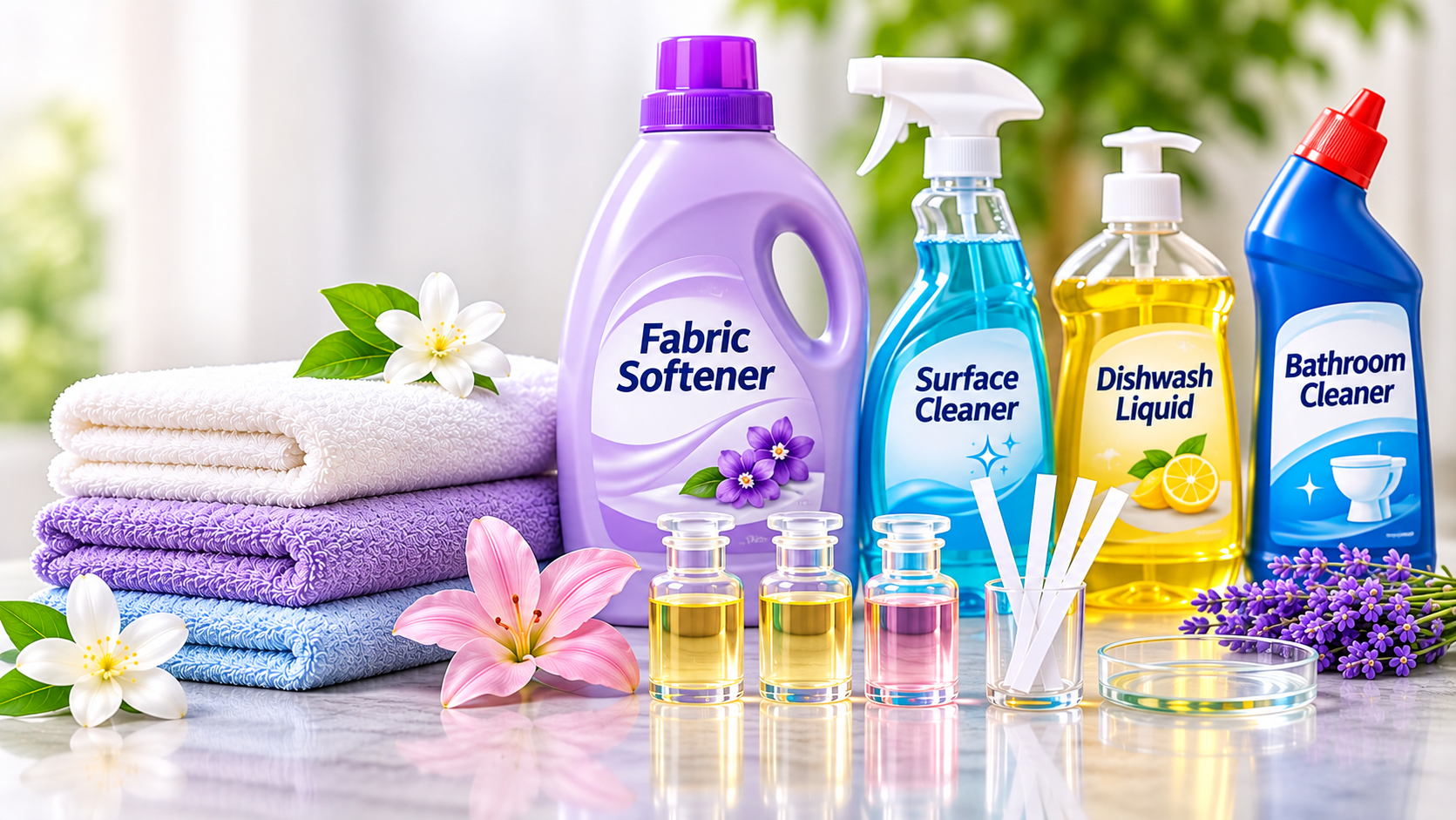
A fabric softener may smell pleasant inside its bottle but leave little noticeable fragrance on clothes after washing and drying. Similarly, a floor cleaner may have an attractive scent when first applied but lose its fragrance character or become unstable during storage.
For home-care manufacturers, selecting the right fragrance involves more than choosing a pleasant aroma.
Fabric softener fragrance must perform in the actual formulation and deliver an appropriate scent experience on treated fabrics. Household cleaning products have different requirements depending on their surfactants, pH, active ingredients and intended use.
This guide explains how manufacturers, formulation teams and procurement professionals can evaluate fragrance ingredients for fabric softeners, floor cleaners, dishwashing liquids and other household cleaning products.
Quick Answer: Choose fragrance ingredients based on the product’s base chemistry, intended scent profile and performance requirements. For fabric softeners, evaluate fragrance retention after washing and drying. For household cleaners, assess compatibility with the actual formulation, including its pH and active ingredients. Test appearance, odour, stability and performance before approving materials for commercial production.
Why Fabric Softeners and Household Cleaners Need Different Fragrances
Fabric softeners and household cleaning products are designed for different applications. Their fragrance requirements should reflect those differences.
| Product | Main Formulation Considerations | Fragrance Performance Goal |
| Fabric Softener | Often uses a water-based conditioning system containing cationic surfactants | Pleasant scent in the product and appropriate fragrance retention on treated fabric |
| Floor and Surface Cleaner | May contain surfactants, solvents and other functional ingredients | Pleasant scent during use without compromising cleaning performance |
| Dishwashing Liquid | Typically surfactant-rich and intended for rinsing | Appropriate fragrance during washing without undesirable residues or lingering odour on dishes |
| Toilet and Bathroom Cleaner | May use acidic or other specialized cleaning systems | Application-specific fragrance compatibility and stability |
| Glass and Multipurpose Cleaner | Often designed for clarity and low visible residue | Suitable fragrance with acceptable clarity, stability and surface finish |
| Oxidizing or Bleach-Based Cleaner | May contain highly reactive ingredients | Only use fragrance systems specifically evaluated and approved for the formulation |
For example, a floral fragrance suitable for a fabric softener may behave differently in an acidic bathroom cleaner.
A fragrance that performs well in one product should not automatically be assumed to work in another.
Manufacturers should begin with the actual product formulation rather than selecting fragrance ingredients only by their smell.
5 Essential Checks When Selecting Fabric Softener Fragrance
The following five checks help manufacturers evaluate fragrance ingredients before production.
1. Check Compatibility With the Fabric Softener Base
Many conventional rinse-added fabric softeners use cationic conditioning systems that influence how fragrance is dispersed and deposited on textiles.
Fragrance ingredients can affect the physical characteristics of these systems.
Potential compatibility problems include:
- Changes in viscosity after fragrance addition
- Separation or changes in emulsion appearance
- Unexpected colour changes
- Altered fragrance character during storage
- Inconsistent fragrance distribution between batches
The formulation’s pH, surfactant system and processing conditions should be considered when testing a fragrance.
Practical recommendation: Evaluate the fragrance in the actual fabric-softener base, at the intended concentration, rather than relying only on supplier fragrance samples.
2. Evaluate Fragrance Retention on Fabric
For fabric softeners, fragrance performance extends beyond the scent inside the packaging.
Manufacturers should assess the fragrance at three important stages:
In the bottle: Does the product maintain the desired scent character during storage?
During washing and rinsing: How is the fragrance perceived during normal product use?
After drying: How much of the intended fragrance character remains noticeable on treated fabric?
This final stage is particularly important for products positioned around a lasting freshness experience.
Some musky, woody and amber fragrance materials are used to contribute depth and persistence in fragrance compositions. However, their actual retention depends on the complete formulation, textile type and use conditions.
Fragrance longevity should be evaluated experimentally rather than assumed from the ingredient family.
For a technical explanation of fragrance deposition and release, see this published study on fragrance performance in fabric softeners.
3. Select Fragrance Ingredients for the Required Scent Profile
A fragrance composition can contain different aromatic materials, each contributing to the finished scent.
| Ingredient Role | Contribution | Common Fragrance Families |
| Fresh Top Notes | Provide an initial impression when the product is opened or used | Citrus, green, fresh and aldehydic |
| Heart Notes | Define the central fragrance character | Floral, herbal and fruity |
| Base Notes | Add depth and contribute to the overall lasting character | Musk, woody and amber |
| Odour-Modifying Materials | Help manage unwanted base odours where suitable | Application-specific masking materials |
The correct balance depends on the brand’s intended fragrance profile and the product’s actual performance requirements.
For example, a premium fabric conditioner might use a floral and musky scent direction, while a surface cleaner might be developed around fresh citrus or herbal notes.
These are fragrance-profile examples, not guarantees of stability or product performance.
Manufacturers developing their own compositions can explore relevant aroma chemicals and assess product-specific technical information.
4. Test Fragrance Concentration and Finished-Product Performance
The appropriate fragrance concentration depends on several factors:
- Product formulation and intended application
- Desired scent intensity
- Fragrance composition
- Compatibility with other ingredients
- Applicable safety restrictions
- Commercial cost targets
Increasing the fragrance concentration does not necessarily improve fabric scent retention.
A higher concentration may affect emulsion stability, viscosity, product cost or regulatory suitability.
Manufacturers should evaluate appropriate concentrations through controlled trials and follow the relevant supplier and regulatory guidance.
5. Review Quality, Safety and Supplier Documentation
Before commercial procurement, confirm which product-specific documents are available.
Depending on the material or fragrance mixture, these may include:
- Product specifications
- Certificate of Analysis (CoA), where applicable
- Safety Data Sheet (SDS)
- Relevant fragrance conformity information
- Applicable allergen information
- Batch identification and consistency details
- Packaging and storage requirements
For fragrance mixtures, request appropriate IFRA Standards conformity information for the intended finished-product category.
An IFRA Certificate of Conformity is prepared by the fragrance-mixture manufacturer. Individual raw materials do not normally carry the same type of certificate.
Manufacturers should also verify applicable local regulatory, labelling and finished-product safety requirements.
For more information, consult the official IFRA Standards guidance.
How to Test Fragrance Retention in Fabric Softeners
A structured testing programme helps manufacturers compare fragrance options and identify possible compatibility issues.
Step 1: Prepare Comparable Formulation Samples
Prepare samples using the intended fabric-softener base.
Record the fragrance identity, batch, concentration, mixing conditions and formulation version.
Include an unfragranced control so changes caused by the base can be distinguished from those associated with fragrance addition.
Step 2: Evaluate Initial Product Quality
Check the appearance and odour of each sample after preparation.
Record relevant properties such as viscosity, pH, colour and evidence of separation.
Step 3: Conduct Controlled Fabric Tests
Use a consistent washing and rinsing procedure, with the same fabric types and product quantities across comparative trials.
Evaluate the fragrance on wet fabric and again after drying.
Cotton and synthetic textiles may produce different results, so test fabrics relevant to the intended consumer application.
Step 4: Compare Fragrance After Drying
Assess whether the desired scent remains perceptible and whether its character has changed.
Where possible, use a consistent evaluation method, defined intervals and trained assessors.
Avoid claiming a fixed number of days of fragrance retention unless that performance has been demonstrated.
Step 5: Evaluate Storage and Packaging Stability
Store finished samples under suitable conditions and assess them periodically.
Look for changes in odour, viscosity, colour, emulsion appearance and packaging compatibility.
Accelerated storage trials may help identify problems, but they do not automatically prove long-term shelf life.
Choosing Fragrance Ingredients for Household Cleaning Products
Household cleaners require an application-specific approach because their formulations vary considerably.
Floor and Surface Cleaners
Floor cleaners may use surfactants, solvents and other functional ingredients.
A fragrance should remain compatible with the cleaning base while providing the intended scent during use.
Manufacturers should check odour stability, clarity where relevant, surface residues and compatibility with the product’s packaging.
Dishwashing Liquids
Dishwashing liquids generally require suitable compatibility with surfactant systems.
Fragrance additions can influence clarity, viscosity and overall sensory performance.
The fragrance should be evaluated in the finished formulation without compromising the product’s intended rinsing performance.
Bathroom and Toilet Cleaners
Some bathroom and toilet cleaners contain acidic ingredients or other specialized cleaning agents.
Fragrance materials that work in a mild surface cleaner may not remain suitable in these formulations.
Manufacturers should use application-specific fragrance guidance and conduct controlled stability assessments.
Bleach-Based and Other Reactive Cleaners
Oxidizing cleaners require particular caution.
Fragrance ingredients may react or degrade in these systems, and an unsuitable addition can introduce safety and stability problems.
Only fragrance systems specifically assessed for the intended cleaner should be considered.
Safety note: Never mix bleach-containing cleaners with acidic cleaners or ammonia-containing products. Fragrance compatibility does not establish the safety of a chemical mixture.
If a product makes disinfecting or antimicrobial claims, those claims require appropriate evidence and cannot be supported by fragrance selection alone.
For related information focused specifically on laundry detergent chemistry, read P. P. Sheth’s guide to fragrance ingredients for laundry detergent manufacturing.
Fragrance Stability and Performance Testing Checklist
A fragrance may smell acceptable immediately after mixing but change during storage or product use.
The finished product should be assessed through a documented testing programme.
| Quality Check | What Manufacturers Should Evaluate |
| Initial Odour | Compare the fragrance with an approved reference |
| Product Appearance | Check clarity, colour, sediment or separation |
| pH and Viscosity | Measure relevant changes after fragrance addition and storage |
| Storage Stability | Evaluate odour and physical changes under suitable conditions |
| Fabric Performance | Compare scent on treated wet and dry fabrics |
| Surface Performance | Evaluate fragrance during cleaning and check for undesirable residues |
| Packaging Compatibility | Test fragrance-containing formulations in the intended packaging |
| Regulatory Review | Confirm application-specific fragrance restrictions and product requirements |
| Batch Documentation | Record supplier identification, specifications and test outcomes |
Testing conditions and acceptance criteria should be selected according to the product formulation and its intended market.
Common Fragrance Problems and How to Investigate Them
| Problem | Possible Cause | Recommended Action |
| Fabric scent fades quickly | Poor fragrance deposition, formulation interactions or differences in use conditions | Evaluate wet and dry fabric performance using controlled trials |
| Fabric softener separates | Incompatibility between fragrance and conditioning system | Compare fragranced and unfragranced controls; review concentration and mixing |
| Clear cleaner turns cloudy | Inadequate fragrance solubilisation or formulation incompatibility | Review the complete surfactant and solubilisation system |
| Fragrance changes during storage | Oxidation or interaction with the product base | Compare retained samples and review storage conditions |
| Cleaning product changes colour | Ingredient interactions or other formulation instability | Investigate the base and fragrance contributions separately |
| Production batches smell different | Raw-material variation or process changes | Review supplier records, approved references and manufacturing conditions |
These are possible causes, not definitive diagnoses. Changes should be supported by controlled testing.
How to Evaluate a Fragrance Ingredient Supplier for Home-Care Products
Consistent sourcing is important when manufacturers need to reproduce a fragrance profile across multiple production batches.
Before approving a supplier, review the exact material or mixture being offered.
Product suitability: Confirm the intended application and available technical information.
Material quality: Check relevant specifications and batch documentation.
Commercial requirements: Confirm the required quantity, packaging format and delivery arrangements.
Sampling: Ask whether evaluation samples are available for the selected material.
Consistency: Establish a process for comparing new batches with approved references.
Documentation: Obtain the relevant safety and conformity information for the intended application.
P. P. Sheth Aromas provides fragrance raw-material and home-care sourcing solutions for manufacturers and brands developing scented products.
Businesses can explore its fragrance raw materials and home-care fragrance solutions to review relevant sourcing options.
Storage and Handling of Fragrance Materials
Proper handling and storage help maintain raw-material quality and support safe production.
Follow the product-specific Safety Data Sheet and supplier storage guidance.
General considerations include keeping containers properly sealed, protecting materials from unsuitable heat and sunlight, monitoring stock age and following relevant hazard precautions.
The appropriate requirements depend on the exact material and packaging.
Do not use a fragrance ingredient beyond its documented suitability or assumed storage life without appropriate reassessment.
Common Mistakes to Avoid
Choosing ingredients only by fragrance strength: A strong scent in the bottle does not guarantee fragrance retention on fabric.
Using one fragrance across unrelated products: A fabric softener and a highly reactive cleaner may require very different fragrance systems.
Increasing dosage without testing: Higher concentrations can cause stability, cost or compliance problems.
Ignoring formulation chemistry: pH, surfactants, solvents and active ingredients can influence fragrance behaviour.
Skipping fabric-use tests: A product can smell appealing in its bottle yet perform differently after laundering and drying.
Ignoring packaging compatibility: Fragrance materials may interact with packaging or change during storage.
Relying on unsupported supplier claims: Verify material identity, technical specifications and available documentation before commercial approval.
Frequently Asked Questions
What Is the Best Fragrance for Fabric Softeners?
There is no universal best fragrance. The correct choice depends on the fabric-softener base, intended scent profile, fragrance retention, regulatory suitability and finished-product testing.
How Can Manufacturers Make Fabric Softener Fragrance Last Longer?
Evaluate suitable fragrance compositions and test how the finished formulation deposits fragrance on different fabrics. Controlled washing, drying and storage evaluations are important. Adding more fragrance alone does not guarantee improved performance.
Can the Same Fragrance Be Used in Fabric Softener and Floor Cleaner?
Possibly, but suitability must be assessed independently in each formulation. Different surfactant systems, pH conditions and intended uses can affect fragrance stability and performance.
Why Does a Fabric Softener Change Viscosity After Adding Fragrance?
Fragrance ingredients may interact with the conditioning or emulsion system. Compare fragranced and unfragranced samples and review the complete formulation before making adjustments.
Which Quality Documents Should Manufacturers Request?
Depending on the material, request a relevant product specification, CoA, SDS and application-specific regulatory information. IFRA conformity information may also be appropriate for a finished fragrance mixture.
How Should Fragrance Ingredients Be Stored?
Follow the exact supplier’s storage and safety instructions. Keep containers properly closed and protect materials from conditions identified as unsuitable in the relevant documentation.
Conclusion: Select Fragrance Ingredients Through Application Testing
Choosing fragrance ingredients for fabric softeners and household cleaning products requires careful attention to the finished formulation.
For fabric softeners, manufacturers should evaluate fragrance retention, emulsion compatibility and performance on treated fabrics. For household cleaners, the priority is choosing a fragrance suitable for the specific cleaning base without compromising product stability, intended function or safety.
Consistent ingredient quality, controlled testing and clear supplier documentation support more reliable commercial formulation decisions.
Looking for fragrance raw materials for your home-care product range?
Explore P. P. Sheth’s fragrance raw materials or contact the team with your intended application, required materials and expected quantity to discuss available sourcing options.