
Choosing the right essential oils for soap & body care products can make the difference between a formulation that performs well and one that fades or irritates skin. Soap makers or body care manufacturers need to understand the role of essential oils. This article clarifies what essential oils are used the most and how to select them by providing details on their properties according to the products they are used in.
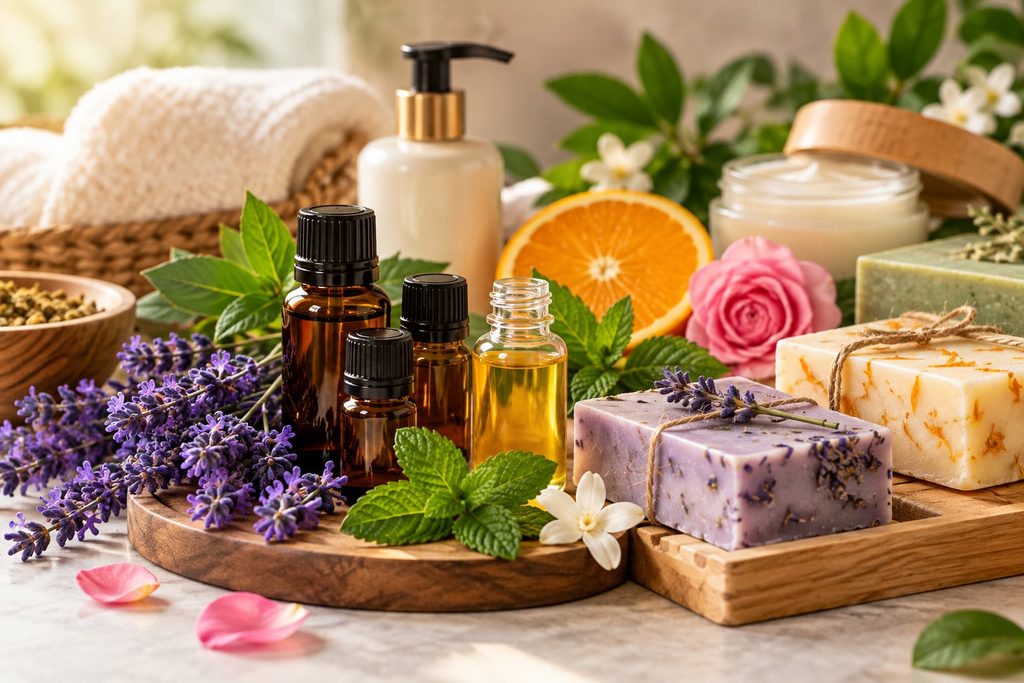
Why Are Essential Oils Used in Soap & Body Care Products?
The use of essential oils in soap and body care products can be attributed to two primary reasons: scent and the functional skin benefits they provide. Essential oils differ from synthetic fragrance oils in being obtained from plant materials, thus making the brands more successful and reliable in the view of eco-friendly product positioning. Many of them also provide additional characteristics such as antibacterial and anti-inflammatory properties, making them a product of greater value than just a fragrance. In addition, for the manufacturers, essential oils make the formulation process easier, as they provide possibilities for creating exclusive fragrance profiles.
Top Essential Oils for Soap & Body Care Products
Some essential oils are better, more popular, and more compatible with the skin than other oils, as are the oils used in soap-making and body care formulas. The following are the most frequently used essential oils in these cosmetic formulations.
Lavender Essential Oil
Lavender essential oil is one of the most commonly used oils in soap-making and body care formulations because of its pleasant scent and mild effects on the skin. Lavender essential oil can easily mix with floral and woody fragrances.
Read also: Lavender Essential Oil: Complete B2B Buyer’s Guide
Peppermint Essential Oil
Condiments also have peppermint essential oil, which provides a cool feeling and an appetising smell. This oil is known for its effectiveness and has been used in body wash and energising soap formulations.
Tea Tree Essential Oil
The benefits of tea tree essential oil come in the form of its antibacterial and antifungal properties, making it a choice among soap makers for their formulations targeted at oily skin.
Orange Essential Oil
The Orange Essential Oil has a pleasant and sweet citrus scent. It is compatible with floral and spicy notes, but it is photosensitive; therefore, it should be used only in wash-off products.
Eucalyptus Essential Oil
The eucalyptus essential oil brings a strong and medical freshness, often used with peppermint or tea tree oils in body wash or soap products.
Lemon Essential Oil
The Lemon Essential Oil is bright and clean, being very useful for an uplifting formulation. However, it should be stored in a light-protected area, as it is easily oxidised.
Geranium Essential Oil
The geranium essential oil has a floral scent and can be used as an alternative to rose oil. The first essential oil is compatible with citrus oils and wood oils.
Patchouli Essential Oil
The Patchouli Essential Oil has an earthy smell as the basis of blends, making the aroma linger longer as well as appearing in the product line focused on naturality.
Frankincense Essential Oil
The frankincense essential oil has a warm and resinous scent and is very useful for helping skin in face soap products.
How to Choose Essential Oils for Soap and Body Care
There are several things to consider when selecting oils for a commercial formulation beyond just picking something that smells good. Manufacturers need to review various practical elements before choosing a specific supplier or formula.
Consider the Desired Fragrance Profile
Start with the fragrance positioning of your product line: calming, energising, fresh, or luxurious. Once this is done, choose the oils that will enhance that stance. Mixing top, middle, and base notes can make the scent more complete, as opposed to using just one oil.
Check Essential Oil Quality and Consistency
Purity and consistency play a role not only in scent but also in skin safety. Look for suppliers that provide cosmetic-grade essential oils and have documentation for their sources and testing.
Consider the Product Formulation
Essential oils react differently based on the base formulation; for instance, cold-process soap will lessen some scents, while creams need oils that emulsify better with other ingredients.
Review Product Specifications
A certificate of analysis shows how pure each oil is and confirms how the oil is extracted and what the most important contents are.
Consider Stability and Storage Requirements
Some oils, such as citrus oils, are prone to oxidation, meaning that they need proper storage to avoid losing their scent before production. Other oils, such as patchouli, have better stability.
Choose a Reliable Supply Partner
In order to get quality bulk essential oils, it is important to find a supplier that can provide dependable sourcing of oil and transparent documentation.
Essential Oils for Different Soap & Body Care Applications
The ideal essential oil to be used depends on the product because the various bases would behave differently with scent.
Essential oils for bar soap
For bar soaps, the oils have to be sturdy enough to endure the saponification process without losing their scent. Therefore, base and middle notes like patchouli, lavender, and geranium perform better than top notes.
Essential oils for liquid soap
Liquid soaps tend to keep fragrances better than bar soaps, hence allowing formulators more flexibility to use brighter citrus and herbal top notes like lemon or peppermint alongside base notes.
Essential oils for body wash
The body wash formulations usually use stimulating oils like eucalyptus, peppermint, and citrus for their compositions.
Essential Oils for Bath Products
Bath products like bombs and salts rely on oils with a strong initial scent throw to ensure the fragrance performs well in water, making calming florals like lavender highly popular.
Essential Oils for Lotions and Creams
Lotions and creams need oils that can combine into the cream base well, as they should not separate. Lighter floral oils and citrus oils are mainly used in the everyday lotions, while richer oils like frankincense are used in the luxury products.
Essential Oils for Skin Care Products
In addition to soap and lotion, oils are commonly used across personal care products such as deodorants, shampoos, and hair care products, where both fragrance and functionality can promote effectiveness.
Buying Essential Oils for Commercial Soap & Body Care Production
Buying essential oils for commercial production necessitates a different approach than buying them in small quantities or as a hobbyist. Manufacturers need reliable supply volumes, cost-effective bulk prices, and documentation that showcases regulatory compliance for the market they operate in. By establishing direct links with a supplier who knows the IFRA regulations and cosmetics manufacturing regulations, manufacturers can avoid formulation complications and compliance issues in the future.
Essential Oil Supplier for Soap & Body Care Manufacturers
PP Sheth Aromas provides essential oils for soap and body care manufacturers across a range of applications, including bar soap and liquid soap production, body wash and bath product formulations, body lotions and creams, and private-label or contract manufacturing projects requiring bulk quantities. So working with an established supplier helps in ensuring good quality products, proper sourcing, and sufficient volume capacity for ongoing continuous production.
FAQs
What are the best essential oils for soap making?
Lavender, tea tree, patchouli, and geranium are among the best essential oils used in soap-making because they keep their scent intact through the saponification process.
Which essential oils are commonly used in body care products?Which essential oils are commonly used in body care products?
Common essential oils include lavender, peppermint, citrus oils like lemon and orange, eucalyptus, and frankincense.
Can essential oils be used in commercial soap manufacturing?
Yes. Manufacturers can use essential oils in soap production but need to account for scent loss during saponification and source consistent, cosmetic-grade oils.
What should manufacturers consider when choosing essential oils?
The main factors of consideration are the aroma profile of essential oils, the documentation of quality, compatibility with the formulation, stability, and having a supplier for bulk purchases with a solid reputation.
Which essential oils are popular for natural soap products?
Lavender, tea tree, patchouli, and citrus oils are noted to be most popular among the soaps that are being termed “natural” or “clean label”.
Can businesses buy essential oils in bulk for soap and body care?
Yes, industrial vendors can supply bulk essential oils with the proper documentation for continuous production runs.
Conclusion
The process of selecting suitable essential oils for soap and body care is ultimately one of tradeoffs between fragrance appeal and practical formulation needs such as their stability, skin safety, and availability. For soap manufacturers, it is crucial to collaborate with suppliers such as P.P. Sheth Aromas that can provide documented, cosmetic-grade essential oils in bulk, which helps ensure formulations stay consistent from batch to batch.