For companies in the personal care, home care, candle, and industrial sectors, a disruption in fragrance supply can halt an entire production process. Choosing the right fragrance chemical manufacturers is not just a procurement decision; it is a long-term operational one.
P.P. Sheth Aromas has developed a network of reliable supply relationships over 5 decades, both in India and abroad. This guide explains to B2B customers how to distinguish between dependable and unreliable manufacturers, how Indian suppliers compare globally, and what to evaluate before committing to a bulk supply partnership.
How Fragrance Chemical Suppliers Support B2B Production at Scale
Reliable outputs are dependent on reliable inputs. Thus, whenever fragrance chemicals arrive either very late, at varying times, or without complete paperwork, the impact will cascade to formulation, packaging, and delivery timelines simultaneously.
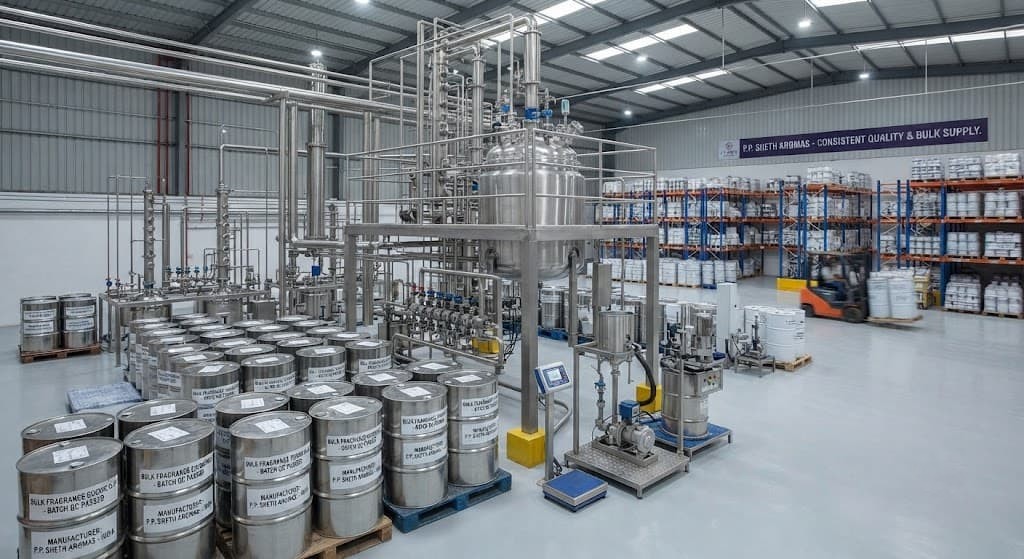
Established fragrance chemicals manufacturers work on a B2B model and rely on established production processes. They are capable of managing the manufacturing process effectively from batch management to raw materials forecasting and the ability to honour volume commitments across quarters.
For a growing business, the aforementioned supply structure is crucial. If your manufacturer follows your production schedule properly, they will be able to minimise lead times and flag raw material shortages before they become your problem.
Meeting Volume Demands Without Compromising Consistency
Scalability is an area in which most suppliers of the mid-tier market do not succeed as such. They are proficient at supplying fewer quantities but have difficulty maintaining consistent aroma quality, correct concentrations, and uniformity in batches.
Reliable companies have standard blending formulas, standard mixers that are calibrated, and standard QC points documented throughout the production process. That means a 50kg order of the same compound will behave exactly the same as a 500kg order, which is the baseline expectation for any serious B2B buyer.
Documentation, Compliance, and Industry Standards
It is mandatory for fragrance chemical manufacturers that are catering to personal care, food-adjacent, or export markets to comply with a predefined regulatory framework. This framework includes:
- FSSAI alignment for using fragrances in food packaging and flavouring,
- BIS certification for relevant chemicals,
- Safety Data Sheets (SDS/MSDS) for every product supplied,
- GST-compliant invoices with appropriate HSN codes for smooth filing of ITC,
- Certificate of Analysis (COA) for each batch indicating purity, GC-MS results and shelf life
Manufacturers supplying export clients need to also obtain documents complying with IFRA standards and REACH if they are exporting to the EU.
Always ask for these documents in advance. Consider reconsidering your partnership with a manufacturer who is not willing to provide these documents.
Fragrance Wholesale Distributors vs. Manufacturers; Which Works Better for B2B?
Buyers often ask this because the answer varies based on their volume, degree of customisation and how much freedom of supply chain control they seek.
Fragrance wholesale distributors offer finished fragrance compounds and sell them in larger quantities. These distributors are a great resource for businesses developing new perfume formulations. They stock many compounds, provide readily available supplies and accept lower MOQs than manufacturers.
Manufacturers, on the other hand, produce compounds directly. Hence, aside from offering competitive prices for larger orders, manufacturers can customise blends, have tighter batch consistency, and direct access to technical support for formulation guidance.
For businesses placing recurring bulk orders of defined compounds, sourcing from fragrance chemical manufacturers almost always delivers better unit economics and supply reliability. The distributor layer adds cost and a dependency point that can hurt you during supply crunches.
At P.P Sheth Aromas, we work within both systems; we are an international supplier of BASF, Emerald Kalama, and Isobionics while offering the supply consistency and documentation depth that B2B manufacturers require.
How Fragrance Oil Suppliers in India Support Growing Businesses
As a source of fragrance oil suppliers, India has become very competitive due to the availability of raw materials, blending expertise, and economies of scale that the Western suppliers are unable to compete with.
Presently, Indian fragrance oil suppliers serve clients in the Middle East, Southeast Asia, Africa, and Europe. The experience gained from working with clients worldwide has forced leading suppliers to improve their production process, documentation, and packaging operability.
Cost Advantage and Export Readiness
Buying fragrance oils from Indian suppliers saves you 25% to 40% compared to European prices for the exact same quality. This does not mean that quality is compromised; rather, it reflects lower manufacturing overhead costs, availability of raw materials in India, and thriving supplier networks in India.
Export ready Indian suppliers are able to provide pricing on both the FOB and CIF basis and provide packaging that is compatible with air and sea freight, as well as CITES documentation for plant-derived materials, along with phytosanitary certification where applicable.
What Indian Suppliers Offer That Others Don’t
Beyond competitive pricing, Indian suppliers possess deep expertise in classic aromatic materials like sandalwood, vetiver, jasmine, and agarwood, fields where India leads the global market. This unmatched heritage gives the country’s fragrance chemical manufacturers a natural advantage in producing the high-quality naturals, isolates, and nature-identical products sought by global perfume and personal care brands.
How to Evaluate and Choose a Fragrance Ingredients Distributor
No matter whether you spend money directly on a company or you work with an aroma ingredient reseller, it is important to assess the supplier based on some parameters that are constant and cannot be compromised.
Quality and Testing Benchmarks
If you want to place bulk orders, make sure to ask for the following information:
- GC-MS (Gas Chromatography-Mass Spectrometry) reports confirming compound purity and the absence of adulterants
- Organoleptic evaluation reports assessing a scent profile for consistency in the batches.
- Heavy metals and allergen testing in personal care products.
- IFRA conformity certificates in relation to leave-on cosmetics formulations.
Accepting oral statements instead of test results is unacceptable. A supplier should be ready to provide all testing information that is in the public domain.
Pricing, MOQ, and Supply Reliability
In addition to quality, assess your supplier based on the following criteria:
- Minimum Order Quantities (MOQ): Ensure these quantities match with your current production volume and opportunity to scale the production without worrying about surplus stocks.
- Lead times: Get everything in writing regarding the lead times and learn about their process of handling season peaks and delays in materials.
- Payment terms: Reputable suppliers usually provide net 30 to net 60 payment terms for verified B2B accounts.
- Sampling policies: Any credible supplier would provide samples prior to bulk transactions, and failure to do so is a valid signal to drop them.
P.P. Sheth Aromas provides samples of our aroma chemicals, essential oils, and fragrance products to ascertain that they will meet the needs of the buyers prior to bulk transactions.
Conclusion
Choosing the right fragrance chemicals manufacturers or distributors impacts the quality of the product, the continuity of production, and the margins. A good partner can offer more than just supply; they can provide consistency, the depth of documentation, compliance readiness, and technological expertise in scaling up production.
With over 50 years in the business of supplying aroma chemicals, essential oils, and fragrances to clients all over India and the world, P. P. Sheth Aromas is well-positioned to meet your bulk fragrance sourcing needs from the first sample to regular production runs.
FAQs
1. What should businesses look for in fragrance chemical manufacturers?
Choose manufacturers that ensure batch uniformity and provide COA and SDS forms, scalable capacity, transparency in prices, and IFRA compliance for trouble free B2B sourcing.
2. How to ensure the quality and reliability of a fragrance chemicals manufacturer?
Check for MSDS, COA, and GC-MS reports, samples, and customer references prior to placing bulk orders.
3. Are fragrance oil suppliers in India suitable for bulk B2B orders?
Definitely! Top-notch Indian manufacturers have all categories of industries, robust production capacity, export oriented facilities, competitive prices, and quality processes.
4. What’s the difference between a fragrance manufacturer and a fragrance wholesaler?
A manufacturer makes chemicals directly and has better design and quality, while a wholesaler distributes products by many brands and specialises in small orders.
5. How to choose a suitable supplier of fragrance ingredients for my industry?
Carefully compare the types of provided documentation, variety of goods, lead times, supply, and types of samples, and ensure that the supplier has quality controls for high volume sourcing.
Most Recent Posts