Dubai is widely known for being one of the world’s largest perfume markets, selling everything from cheap eau de toilettes to rare oud oil-based fragrances that can be more expensive than a piece of jewellery. But what actually separates an AED 100 bottle from an AED 10,000 one? It isn’t packaging or branding alone; it’s what’s inside.
When it comes to the perfumes Dubai is so famous for, it is important to become knowledgeable about the components of the fragrances. This guide will help you learn about the ingredients, concentrations, and sourcing decisions that determine the price of perfume as well as how long it can last.
What Makes a Perfume High Quality?
A high-quality perfume isn’t only about how it smells on first spray; it also matters how good the fragrance continues to be. In other words, its quality is dependent on three aspects: the quality of the ingredients, the experience of the perfumer who has created a new formula, and how well the fragrance performs over time on skin. More affordable perfumes are mostly made from a few artificial aroma chemicals, which produce a pleasant but monotonous scent. Expensive perfumes are based on natural extracts and resins combined with a small amount of artificial chemicals, which helps create top, heart, and base notes that shift over several hours rather than fading into a single note within minutes.
Key Ingredients That Affect Perfume Price and Quality
Some raw materials cost a few dollars a kilogram; others cost more than gold by weight. Here are the ingredients that most influence what you pay.
Oud and Agarwood
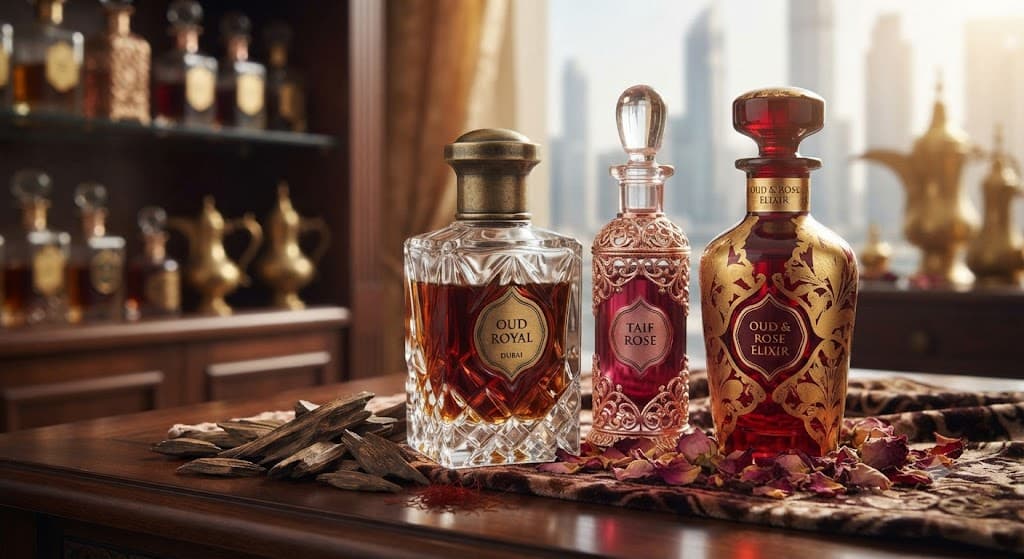
Oud is perhaps the most significant factor in determining prices in Arabian perfumes. It is the resin obtained from the trees of agarwood infected by a certain mold. As a result, natural oud oil of good quality usually takes many years to get produced and is acquired in very small quantities. Authentic oud oil from Cambodia or India is considered one of the costliest raw ingredients in the perfume industry. Hence, those rose perfumes with prominent oud notes in Dubai are generally much higher in price than perfumes having flowery notes.
Rose and Rose Extracts
Rose absolute and rose otto are precious oils. They have a rich scent profile and require enormous amounts of rose petals: hundreds of tons to produce one kilogram of oil. The varieties of roses that rank the highest are Bulgarian and Taif roses (the latter being cultivated near Mecca), which are commonly used in luxury Arabian perfumes for their rich, slightly spiced rose character.
Jasmine and Other Floral Ingredients
Jasmine absolute is another labor-intensive natural ingredient; petals must be picked at night when there is the strongest aroma. Besides jasmine absolute, oils such as tuberose and ylang-ylang create a luxurious floral scent that is difficult to replicate synthetically, keeping its price and presence in premium compositions high.
Saffron and Spices
Saffron, as well as spices such as cardamom, cinnamon, and pink pepper, provides warmth with gourmand notes typical of Middle Eastern perfumes. It is worth noting that saffron is among the most expensive of spices, and even small concentrations of it in a formulation substantially increase the cost of production.
Amber, Musk, and Resinous Materials
Amber (which in most cases is a mixture of labdanum, resin, and vanilla rather than a true fossil amber) and musk serve as bases for fragrances and add depth to fragrance creations. Modern perfumery choose to work with synthetic musk due to ethical and regulatory reasons; however, organic resins, including labdanum, are still expensive and are prized for the warmth they bring to Arabian-style compositions.
Natural vs Synthetic Ingredients in Perfumes
The question is not whether natural or synthetic ingredients are better; the question is how effectively they can be made and if the ingredients can be sourced well enough.
Natural Perfume Ingredients
Natural extracts offer complexity that’s hard to fully replicate. For instance, one rose essence contains hundreds of constituents that are necessary for bringing the aroma about. Natural oils are expensive because they have very low extraction rates; they can only be harvested at certain times of the year and require a lot of processing.
Synthetic Aroma Chemicals
Modern aroma chemicals do not indicate a cheap perfume; many of them are crucial for perfumery. Synthetics like Iso E Super, Ambroxan, and various musk molecules allow perfumers to achieve certain effects that cannot be achieved with natural materials only (for instance, long-lasting sillage or a ‘skin scent’ quality). High-quality aroma chemicals also solve real needs: consistency for every batch, ethical sourcing of materials (e.g., in terms of animal-derived musk), and price stability. The point is in whether the formula uses cheap and poorly performed synthetics to spare money or high-quality aroma chemicals to enrich the mix.
How Perfume Concentration Affects Price and Quality
“Concentration” is a term that denotes the ratio of aromatic substances (the perfume oil) in the mixture with alcohol and water bases. The higher the concentration, the stronger, longer-lasting, and typically more expensive the fragrance.
- Eau de Cologne (EDC): Concentration is 2-4%, which is the lightest type of perfume that has a short time effect and is priced lower than others.
- Eau de Toilette (EDT): Concentration: 5-15%, which is the most popular type of perfume, a common everyday strength with moderate longevity.
- Eau de Parfum (EDP): Concentration is 15-20%, which is the most popular tier in Dubai’s premium market.
- Parfum/Extrait: Concentration ranges from 20 to 40%, which is the strongest and most expensive form, often used for the most precious ingredients like oud and rose.
The concentration has an effect on the price because, if there is a relatively high ratio of oil, there is more raw material in each bottle. Therefore, if the oil contains rare ingredients like oud, the cost can increase significantly. Concentration affects how customers perceive the product; for instance, well-blended EDP and extrait fragrances evolve better on the skin, revealing different notes, while fragrances with lower concentrations are more straightforward and disappear faster. Still, a high concentration level does not equal a higher quality level; in fact, an exceedingly good EDT may be more pleasant than a poorly created extrait.
How Raw Material Quality Changes the Final Perfume
Even within the same ingredient category, quality varies enormously. Oud from the wild, naturally infected agarwood, is quite different from oud obtained through artificial inoculation; the latter one is easier to obtain than the former one owing to its less complex characteristics. Such properties can also be seen in aroma chemicals: synthetics of pharmaceutical grade are well-purified, mix flawlessly, and stay on skin longer, while lower-grade versions can smell harsh or degrade quickly.
Why Some Perfumes in Dubai Cost More Than Others
In Dubai’s perfume industry, the variations in pricing are not attributed to only one reason, as it takes an entire list of causes into account, such as the mixture of natural ingredients with synthetic ones, the concentration level, the rarity of key notes like oud or saffron, and the reputation and craftsmanship of the perfume house. In fact, niche and independent Emirati perfumers who use rare ingredients for their creations have higher prices than mass-production perfumes made with the use of synthetic ingredients. Both can be well-made, but they’re built for different markets.
Ingredients That Influence Perfume Longevity
Longevity is primarily influenced by base notes and fixatives, substances responsible for slowing down the evaporation of a fragrance and anchoring it to the skin. The use of resinous materials (for example, amber or labdanum, or even oud) together with musk compounds ensures the length of time a perfume lasts. Arabian perfumes known for their scent with high proportions of bases last considerably longer compared to Western fragrances based predominantly on lighter citrus and floral notes thanks to their usage of heavy and slow-evaporating base materials.
What to Look for When Comparing Perfume Quality
To truly judge a perfume’s quality, you need to ignore the marketing hype and look closely at how it is made and how it performs. A high-quality fragrance will feature a transparent breakdown of its top, heart, and base notes rather than a vague description of its blend. The label should clearly state the concentration percentage and highlight key natural ingredients like oud, rose, or saffron. Finally, never judge a scent just by the first spray; instead, evaluate how the perfume develops on your skin over four to six hours.
FAQs
What ingredients make perfumes more expensive?
Rare naturals like oud, rose, jasmine, and saffron, plus high-grade aroma chemicals and higher concentrations.
Does oud make a perfume more expensive?
Yes, since Oud is a natural product that is not available in large amounts, it requires many years to be processed and makes perfumes expensive.
Are natural perfume ingredients better than synthetic ingredients?
Not necessarily; natural substances enhance complexity, while synthetic substances increase the consistency of perfumes.
Which raw materials improve perfume longevity?
Some of them are in the basis of the perfume structure, such as amber, labdanum, oud, and musk.
Does a higher perfume concentration mean better quality?
Not automatically; it means a stronger, longer-lasting scent, but quality still depends on the blend.
Why are some Dubai perfumes known for strong and long-lasting scents?
The formulation of these fragrances is done in higher concentrations with slow-evaporating base notes, including oud, amber, and musk.
Conclusion
In Dubai’s luxury fragrance market, the price and quality of a perfume in Dubai come down to what’s actually inside the bottle: the raw materials, from rare natural ingredients like oud and rose, to the precision of its concentrated aroma chemicals. For brands and perfumers who source directly, partnering with a trusted, time-tested supplier like P.P. Sheth Aromas ensures the flawless raw inputs needed to create truly unforgettable scents.
Most Recent Posts